
Dialogue with
Shareholders & investors EXEDY 's Financial Strategy and Transformation Trajectory
This article outlines our thinking and future direction based on key opinions and questions received during dialogues with shareholders and investors. Under our growth strategy centered on the AT business, we have accumulated equity capital over many years in order to balance capacity expansion investments with ensuring financial soundness. Meanwhile, the business environment has changed significantly due to the progress of electrification, and we have proactively responded to these changes by transforming our business portfolio and reviewing our financial strategy, working to achieve an optimal capital structure and improve capital efficiency. As a result, ROE has turned to a recovery trend, and PBR has also risen above 1.0x, showing improvement in our valuation from the capital market. However, the focus of our dialogues with shareholders and investors is already shifting to what lies beyond this.
"We need to transform into a company that makes its own decisions and pioneers new markets."
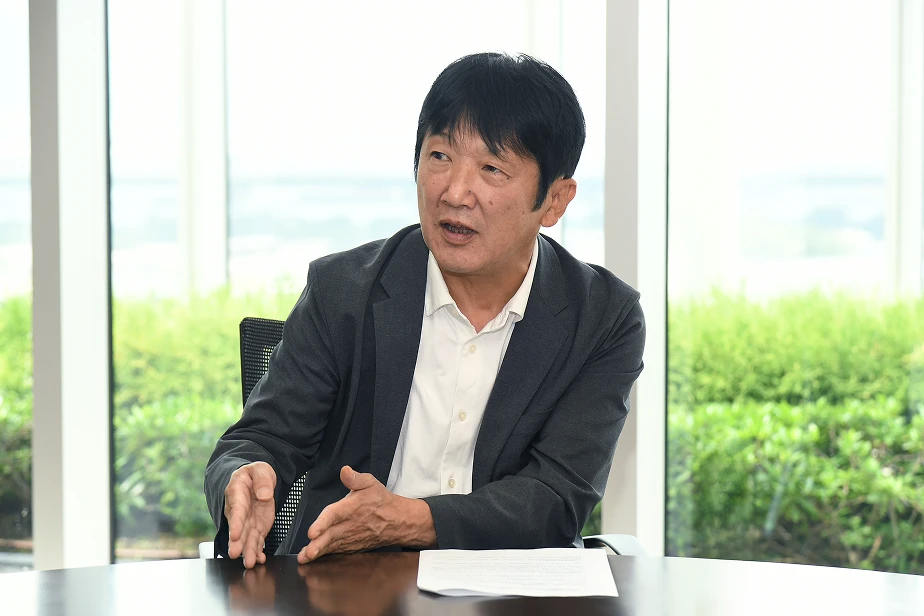
Hiroshi Toyohara, Director, Representative Executive Officer, Executive Vice President; Executive General Manager, Corporate Strategy Promotion Headquarters, will discuss the results of the financial strategy and the strategies for improving profitability and growth that lie ahead.
Background of the transformation
In recent years, in addition to strengthening investor relations (IR) activities, EXEDY has also been reviewing its capital policies, including share buybacks and increased dividends.
Could you please explain the background and objectives behind these initiatives, including the termination of the capital alliance with Aisin Corporation in May 2024?
Many investors believe that the termination of our capital alliance with Aisin Corporation in May 2024 was the catalyst for change. However, in reality, we had been implementing structural reforms in both our business and financial strategies even before that. Our strong equity base up to that point was rational given the business environment at the time. Since the 2010s, our torque converter business for automatic transmission vehicles has expanded globally, requiring continuous investment to increase production capacity. Our partnership with Aisin Corporation was one of the important initiatives supporting this global expansion of our automatic transmission business. In order to expand our business while fulfilling our responsibility for stable supply, it was important to prioritize financial soundness and secure investment funds as equity capital.
On the other hand, since around 2019, in light of the progress towards BEVs, it has become necessary to factor in the medium- to long-term risk of contraction of the AT business. Therefore, we have been preparing for the creation of new businesses and the transformation of our business portfolio, starting with the formulation of our Long-Term Vision-term vision in 2021, and in 2024 we formulated Mid-to Long-Term Strategy and Mid-Term Management Plan, "Transformation REVOLUTION 2026." The dissolution of our capital alliance with Aisin Corporation was a major turning point, but it did not mean that the transformation began for the first time. Rather, we see it as an opportunity to accelerate the transformation that we had been pursuing up to that point.
Furthermore, we had fully anticipated changes in our shareholder structure. I actually saw this as a good opportunity, and through repeated dialogues with our 7 major shareholders, I directly confirmed market expectations regarding capital efficiency and shareholder returns, and reflected these findings in our financial strategy. In other words, the review of our financial strategy is not simply a response to changes in the shareholder structure. It is an initiative to promote structural transformation in both business and financial strategies, taking into account changes in the business environment. And what was important in this process was redefining "what is the optimal capital structure for our company."
Evolution of financial strategies in response to changes in the business environment

Click the image above to enlarge it.
Shift in financial strategy
How was the optimal equity ratio determined and achieved?
The purpose of reviewing our financial strategy was not simply to reduce surplus capital. Rather, as we proceed with transforming our business portfolio, our goal was to shift to a capital structure that balances growth investments with shareholder returns. Therefore, we first re-examined what constitutes an appropriate level of equity for our company.
In our analysis, we primarily focused on three perspectives. First, we examined the balance sheet. We calculated the risk level for each asset item and scrutinized the amount of capital necessary for business continuity by aggregating these risk amounts. Second, we conducted an analysis based on trade-off theory. We confirmed an appropriate capital level for our company, taking into account the balance between the cost of capital and financial risk. Third, we considered credit ratings. We determined the level that would allow us to maintain the creditworthiness necessary for stable business continuity and low-cost financing.
After comprehensively considering these factors, we determined that the optimal equity ratio for our company is 60%. Based on this, we identified the amount of surplus capital while ensuring the financial soundness necessary for business continuity and growth investments, and have flexibly implemented capital policies, including share buybacks and dividend increases. In addition to improving capital efficiency, we also utilized syndicated loans to promote management with a greater focus on ROIC while securing funds for growth investments.
Our goal is not simply to reduce equity capital, but rather to shift to an appropriate capital structure that reflects business risks and to adopt a management approach that is mindful of the cost of capital.
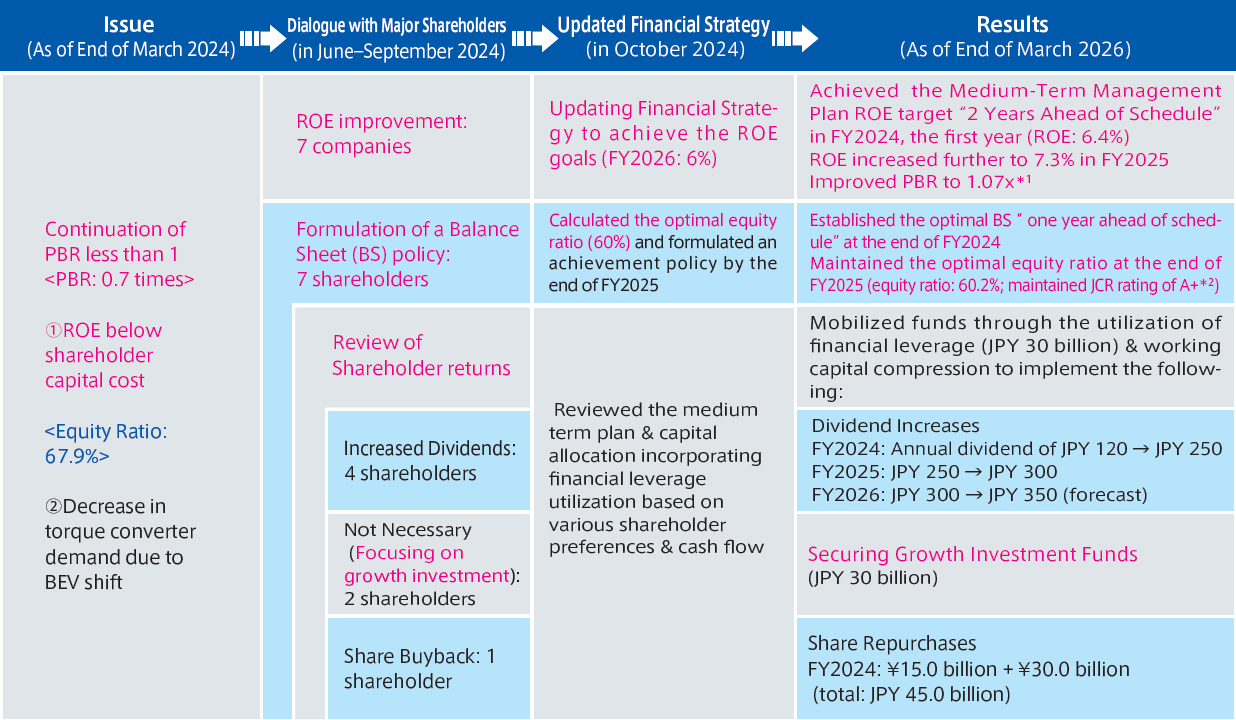
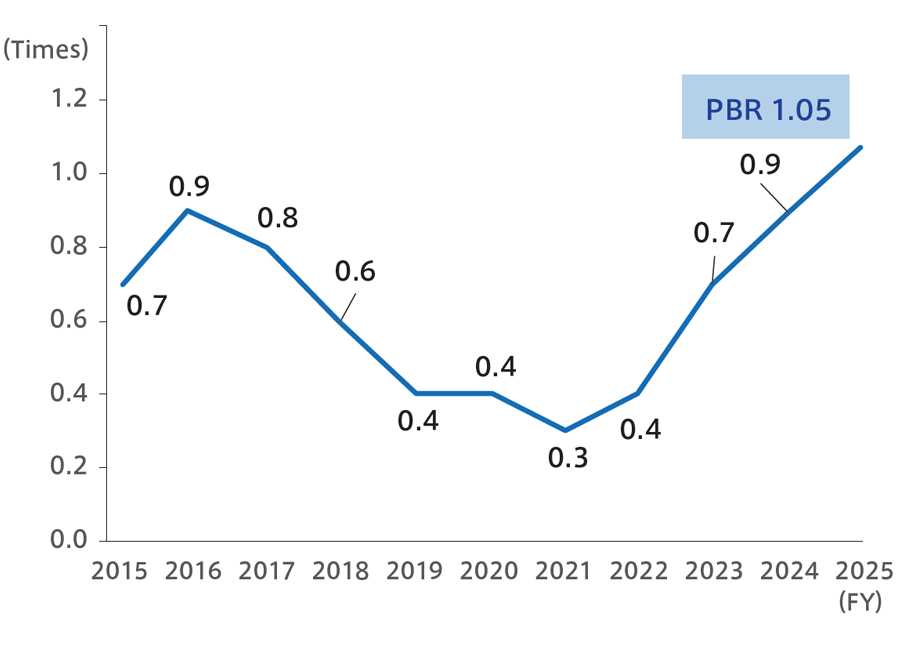
As a result of these efforts, we achieved, in the first year, our ROE target of 6.0% originally set for the final year of the Mid-Term Management Plan, and we have also seen a shift in market perception, with PBR rising above 1.0x.
Shift in financial strategy based on dialogue with shareholders
- *1 As of the end of March 2026
- *2 Announced on April 15, 2026
Based on dialogue with shareholders, we will review our financial strategy, secure a growth investment framework, and strengthen shareholder returns.
Improved capital efficiency leads to higher ROE and elimination of a PBR below 1.
The concept of the optimal equity ratio
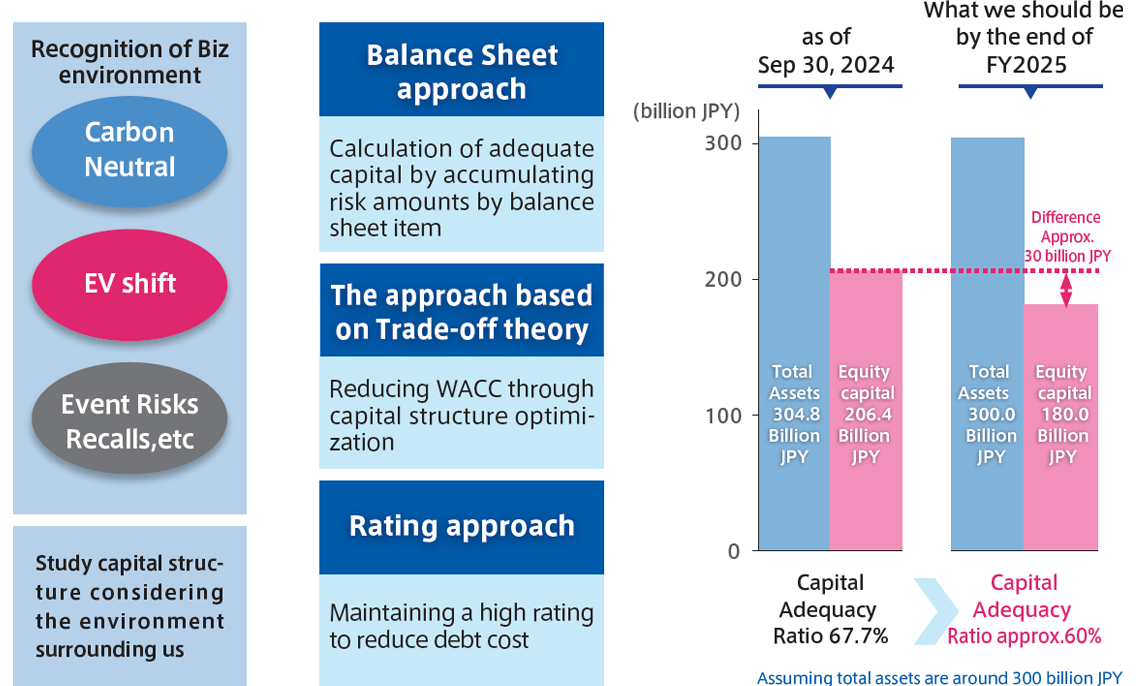
Taking into comprehensive consideration the business environment, cost of capital, creditworthiness, etc., the optimal equity ratio is set at 60%.
Achieve optimal capital structure by March 2025(improved ROE and recovery of PBR to above 1.0x).
Trends in ROE improvement and capital market valuation
① ROE trend
ROE is on a recovery trend after a temporary decline.
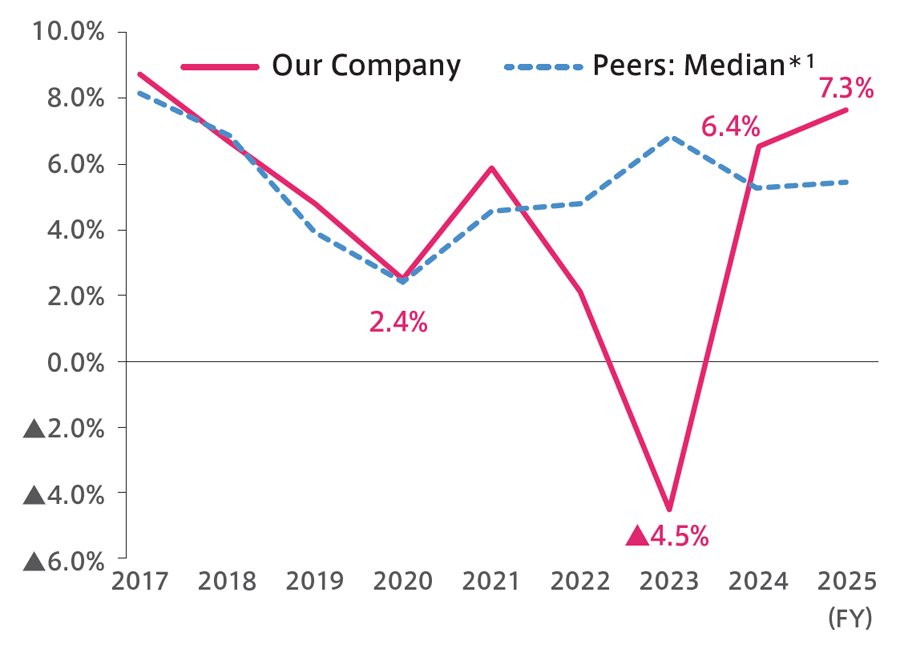
*1 24 automotive parts manufacturers listed on the Tokyo Stock Exchange Prime Market, classified as transportation equipment.
② DuPont disassembly
The increase in ROE is due to improvements in net profit margin and financial leverage.
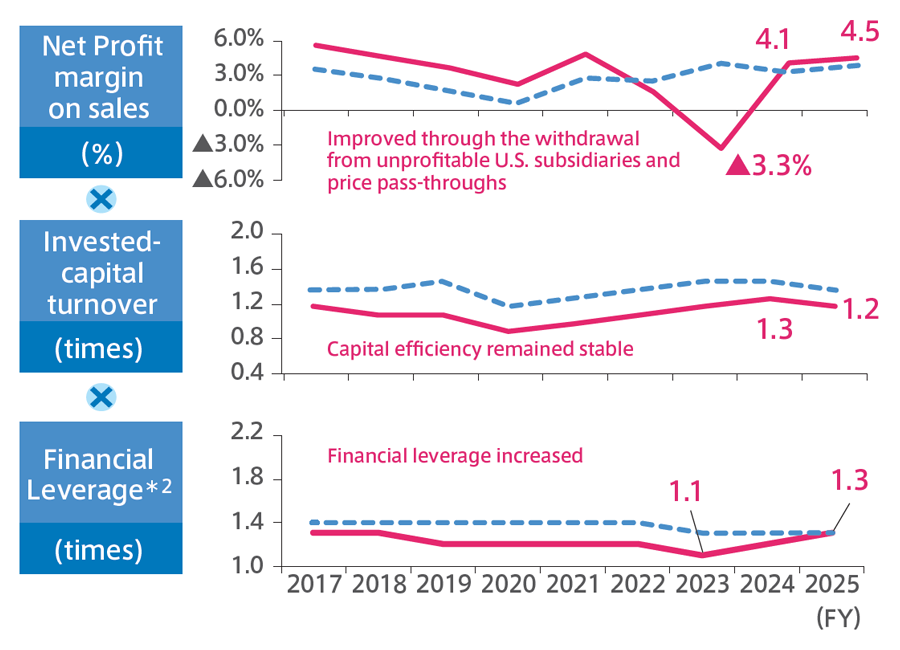
* Calculated as invested capital ÷ shareholders' equity (average at the end of the fiscal year).
③ PBR trend
PBR has risen above 1.0x as ROE has improved.
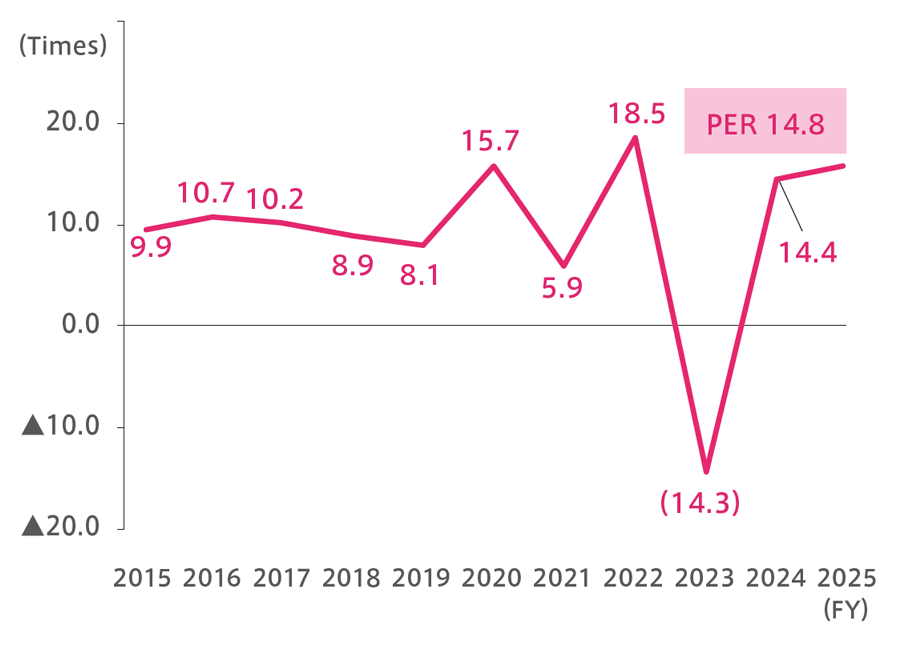
④ PER Trend
While capital market valuations have improved, further fostering growth expectations remains a challenge.
Strengthening the profitability of core businesses
We anticipate a decline in sales volume for our main product, internal combustion engine-related parts.
Given these circumstances, how do you plan to ensure profitability?
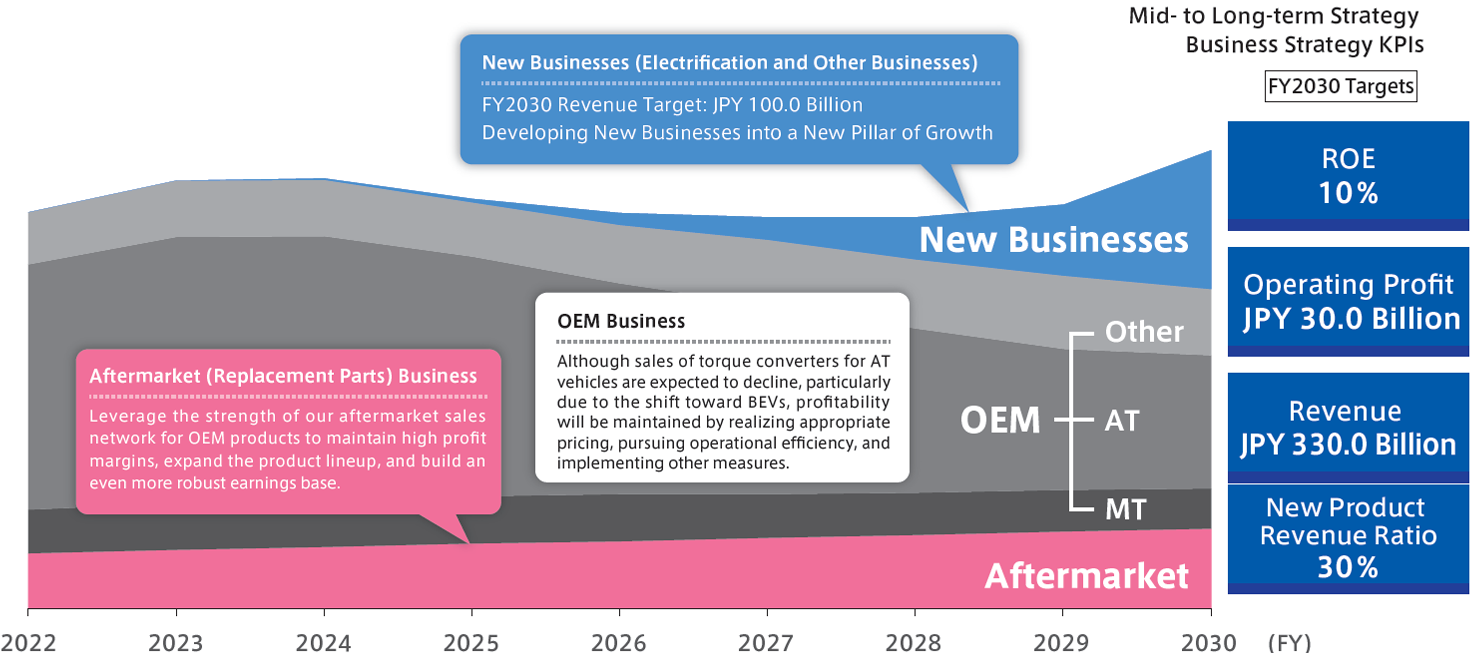
It is generally assumed that businesses related to internal combustion engines will shrink significantly in the future, but in reality, the outlook needs to be viewed from a broader perspective. Demand for torque converters for automatic transmission (AT) vehicles is indeed expected to decline over the medium to long term as electrification progresses. However, this does not mean that our entire AT business will contract at the same pace. For AT clutches, which account for 40% of sales in our AT business, we expect the decline in demand to be more gradual than that for torque converters. We also expect a certain level of demand for our manual transmission (MT) business to continue in both the OEM and aftermarket businesses, and therefore do not expect our core businesses as a whole to contract rapidly. At the same time, we need to shift away from the traditional model of expanding profits through increased sales volumes. Going forward, rather than pursuing volume, it will be important to maintain and improve profitability through appropriate pricing.
We take two main approaches to pricing. The first is price pass-through, whereby increases in raw material and labor costs are appropriately reflected in selling prices. The second is establishing appropriate prices that enable us to secure the profits necessary to sustain our business and fulfill our responsibility to ensure a stable supply. For torque converters in particular, even as sales volumes decline, we will continue to have a certain responsibility to supply our products. We are therefore engaging in careful dialogue with our customers regarding price levels that will enable us to maintain a stable supply over the long term.
Our aftermarket business, which handles replacement parts, will also be an important source of earnings going forward. This business is more profitable than our OEM business and is also an area where we can leverage our strengths, including our global sales network and strong brand. Going forward, in addition to our existing MT replacement parts, we will expand our product lineup to include AT components, brakes, suspensions, and other products, with the aim of building a more robust earnings base.
Our core businesses are the driving force behind our future business portfolio transformation. While factoring in the decline in demand for torque converters, we will leverage the strengths of our AT clutch, MT, and aftermarket businesses and secure profits through appropriate pricing and highly profitable businesses, thereby maintaining our ability to generate stable cash flows.
Taking on a new business challenge
From fiscal year 2026 to 2027, we will face a period where sales from existing businesses decline and new businesses are launched simultaneously.
How will you balance strengthening the profitability of your core businesses with investing in new ventures?
We believe that fiscal 2026 and fiscal 2027 will be a critical phase for our company. While sales in our core businesses are declining, our new businesses are still in the process of being established and have yet to make a full-fledged contribution to earnings. In other words, we are entering a transitional phase in our business portfolio transformation.
To navigate this phase successfully, it is essential that we continue to generate solid profits from our core businesses. By implementing appropriate pricing, reviewing our cost structure, and expanding our aftermarket business, we will maintain and strengthen the profitability of our core businesses and allocate the cash generated from them to the development of new businesses.
However, this does not mean that we will continue every new business initiative. We have introduced the stage-gate method to assess the feasibility of commercialization and the likelihood of achieving profitability for each investment project. At each stage of development and commercialization, we assess factors such as the value proposition, profitability, market potential, and potential business scale to determine which projects should be continued and which should be reconsidered.
For example, with regard to in-wheel motors, whether they are adopted for mass production will be a major decision point going forward. If they advance to the mass-production stage, growth in sales volumes and their contribution to earnings will become more tangible. On the other hand, if progress falls short of expectations, we will determine whether to continue the business based on the results of our assessment at that point. For other new businesses, including drones and commercial e-mobility, we are also assessing market needs and the conditions necessary for commercial viability on a project-by-project basis.
The key is not to depend on a single project, but to pursue multiple opportunities while concentrating management resources on areas with strong growth potential. We will redirect profits generated by our core businesses toward the next areas of growth, while reviewing projects for which there is no clear path to profitability. By thoroughly applying this approach of selection and concentration, we will steadily advance our business portfolio transformation.
Towards fiscal year 2030
Business portfolio transformation image
What We Want Investors to Know
Finally, from what perspective would you like investors to evaluate EXEDY going forward?
Going forward, we would like investors to pay attention to 2 major achievements.
The first is whether our core businesses are consistently generating profits. Even as sales volumes decline, it is crucial to maintain and strengthen stable profitability through appropriate pricing and the expansion of our aftermarket business. The second is whether our new businesses are steadily becoming established as sources of earnings.
As we move forward with our business portfolio transformation, we need to demonstrate not only the growth potential of our new businesses, but also the likelihood of achieving profitability and the expected timeline for doing so. We want investors to understand the stage each business is at and how it will contribute to enhancing corporate value.
Until now, market assessments have focused primarily on our financial strategy, including share buybacks, dividend increases, and the achievement of an optimal capital structure. However, our financial strategy is ultimately about laying the foundation for enhancing corporate value. We are now entering the stage of executing our business strategy on that foundation and strengthening our earnings power.
We are transforming from a company valued primarily for its financial strategy into one valued for the results of its business strategy. We will continue to engage in dialogue with our shareholders and investors and incorporate their candid feedback into our management. By strengthening the earnings power of our core businesses and driving the growth of our new businesses, we will strive to further enhance corporate value.