
Compliance
Basic Approach
Our group bases its corporate activities on compliance with the laws and regulations of each country and transparent management, and promotes compliance management with "fairness and transparency" as its keywords. Under our corporate governance system, we thoroughly understand and comply with laws and regulations related to our business operations, and strive to improve the reliability of our corporate activities. We position these compliance activities as an important part of risk management and are working to prevent compliance violations and respond to them early. Our basic approach to compliance and corporate ethics is stipulated in the EXEDY Code of Conduct.
Governance Structure
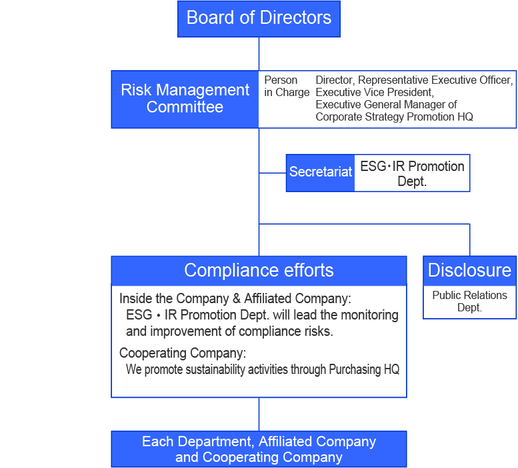
We have established a Risk Management Committee as a subordinate committee of the Board of Directors, and have entrusted this committee with the responsibility of overseeing serious cases, including human rights and compliance. The committee operates through the participation of members of the management team, with the Representative Executive Officer, Executive Vice President and Executive General Manager of Corporate Strategy Promotion Headquarters serving as the overall person responsible for risk management. The committee receives reports on initiatives related to human rights and compliance, compliance violations, and the status of related investigations, and deliberates on these matters. The committee meets at least twice a year, and the matters deliberated and decided are regularly reported to the Board of Directors. Based on these reports, the Board of Directors oversees all initiatives related to human rights and business ethics and compliance. In practical terms, the ESG/IR Promotion Department is the department in charge of compliance initiatives and promotes measures in cooperation with relevant departments.
Initiatives
We promote compliance risk management through a series of control processes ranging from risk identification to remediation and monitoring. The status of these efforts is verified through various means, including internal audits conducted by our Global Audit Department.
Compliance Risk Management Process

① Identifying Risks
Compliance Awareness Survey
We conduct an annual compliance awareness survey to understand and identify compliance risks. For fiscal year 2025, we conducted a survey targeting officers and employees (excluding temporary staff) of our company and 12 domestic affiliated companies. The questions covered workplace compliance awareness and the presence or absence of compliance violations. The response rate was 86% for our company and 81% for the 12 domestic affiliated companies. As a result, we identified "power harassment" and "working time management" as key risk items, as these two areas raised concerns about risks across the entire group. In addition, while we worked to improve awareness of our reporting and consultation hotline in the previous year, and awareness of the hotline improved at both our company (82% to 96%) and our domestic affiliated companies (65% to 81%), approximately 20% of respondents said they "don't consult even if they have a problem" for reasons such as not knowing what kind of response they would receive, which we recognized as an issue that needs to be corrected.
Whistleblowing System
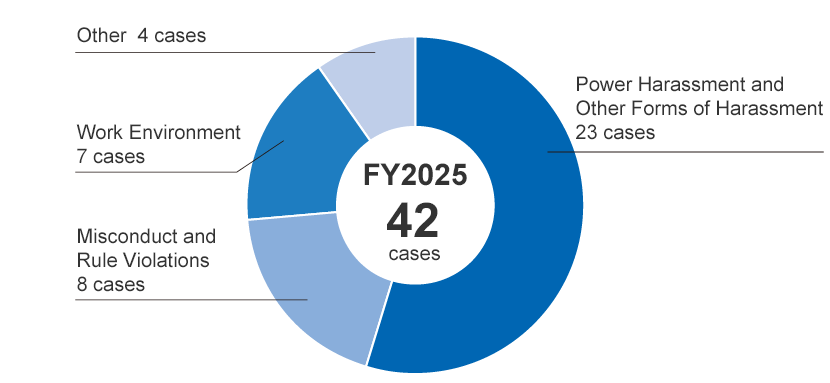
Number of internal whistleblowing cases in fiscal year 2025 Our group has established an internal whistleblowing system to identify and correct violations of laws and regulations and misconduct. We prohibit any adverse treatment of whistleblowers and thoroughly protect them, and in addition to an internal contact point, we have also established an external contact point handled by external lawyers. This system is operated for our company and domestic affiliates, and overseas affiliates also have their own whistleblowing contact points and are managed to operate in accordance with the group's basic policy. We promptly investigate the content of reports and take corrective measures and preventive measures as necessary, and in the case of a serious compliance violation, we report it to the Board of Directors and consider how to respond. The fact that the number of cases related to "power harassment and other forms of harassment" was the highest in fiscal year 2025 has also been reflected in the identification of key risk items.
② Correction
Compliance training & Addressing Key Risks
We decided to post the survey results described above, along with the key risk items ("power harassment" and "working hours management") and the response flow for the reporting and consultation services, in the workplaces of our company and our domestic subsidiaries. We also conducted compliance training focusing on the key risk items and raising awareness of the use of the reporting and consultation services. The training was conducted using materials prepared by our company and targeted all 2,772 employees of our company (excluding part-time employees), as well as employees of 15 domestic subsidiaries. Furthermore, the ESG/IR Promotion Department visited six domestic subsidiaries whose survey results were unsatisfactory, met with the presidents and compliance officers, and engaged in dialogues toward improvement and awareness campaigns to promote the use of the reporting and consultation services. Some compliance officers at each company were struggling to handle consultations, so we plan to provide support to such officers in the future.
③ Monitoring
Internal Audit
We position the Global Audit Department as an independent organization directly under the President and are committed to ensuring the effectiveness of our compliance activities through internal audits. The department reports the results of internal audits to the President and strives to improve the effectiveness of the audit function through information sharing with the Audit Committee and the Accounting Auditor.As a result, internal audits contribute to the sound management of the entire organization as an important function for monitoring our compliance risks. Specifically, we conduct regular audits of our company and our domestic and international subsidiaries, including the dissemination and thorough implementation of our ethics and compliance policies (including anti-corruption and anti-bribery measures), compliance with laws and regulations, and the operation of our internal whistleblowing system. We conduct audits annually on important business processes and key departments. Domestic subsidiaries are audited annually, while overseas subsidiaries are audited approximately every 3-4 years, with targets selected based on their importance from an internal control perspective.
During audits, we verify the level of dissemination and enforcement of ethics and compliance policies, including anti-corruption and anti-bribery measures, as well as the operation of related controls. We request corrective actions as necessary and strive to promote adherence to these policies.
Anti-corruption Initiatives
Our group's sustainability policy stipulates our commitment to preventing all forms of bribery and corruption, including coercion to provide benefits, bribery, bid rigging, conflicts of interest, money laundering, and fraudulent accounting practices. Furthermore, the EXEDY Code of Conduct sets forth detailed rules of conduct regarding anti-bribery and anti-corruption, which are disseminated and thoroughly implemented throughout the entire group. We have established these policies and standards of conduct that our officers and employees must adhere to, and we position them as our fundamental policy regarding ethics and compliance.
Reflection in the Code of Conduct
The EXEDY Code of Conduct sets forth the following provisions regarding anti-bribery and anti-corruption:
Basic Principles (excerpt from the sustainability policy)
We strive to conduct fair business activities by complying with applicable domestic and international laws and regulations, respecting the culture and history of each region, and maintaining healthy relationships with local governments. In particular, we strive to prevent all forms of corruption, including the extortion of benefits, bribery, bid rigging, conflicts of interest, money laundering, and improper accounting practices, and will not engage in any violations of laws and regulations related to competition laws, bribery control laws, export control laws, etc.
<Rules of Conduct>
- Business Laws and Regulations
- Prohibition of cartels
- Practicing fair trade with partner companies
- Compliance with relevant laws and regulations, including the Antimonopoly Act and the SME Transactions Act
- Prohibition of insider trading - Entertainment and gifts (prevention of bribery)
- Prohibition of entertainment, gifts, and monetary exchanges for the purpose of obtaining or maintaining unfair benefits or preferential treatment.
- Obtain approval from your supervisor when receiving hospitality. - Anti-corruption
- Compliance with national laws and regulations regarding political contributions and donations.
- Prohibition of falsification or alteration of quotations, purchase orders, etc.
- Prohibition of fictitious transactions and other transactions without substance
Prohibition of improper accounting practices
- Prohibition of money laundering
Dissemination and Training of Employees
The EXEDY Group Code of Conduct sets forth matters related to corporate ethics and compliance, including the prevention of bribery and corruption. We conduct a reading of the Code of Conduct for all employees (including part-time and contract employees) at each workplace every six months. We also check the implementation status of these readings every six months to continuously monitor the understanding and dissemination of the Code of Conduct.
Engagement with Suppliers
For new suppliers, we provide them with our "Supplier Sustainability Guidelines" and request their commitment to anti-corruption measures. Those who agree enter into a basic transaction agreement that requires compliance with anti-bribery provisions and anti-corruption requirements. Furthermore, both new and existing suppliers utilize our sustainability assessment form to conduct self-assessments regarding compliance with competition laws and risk assessments related to anti-corruption. In fiscal year 2025, 283 suppliers conducted these self-assessments.
Responses when corruption cases occur
In the event of a serious corruption incident, overall person responsible for risk management is required to report the incident and measures to prevent recurrence to the Board of Directors. We have also established reporting channels that ensure privacy protection and protect those who seek consultation from any disadvantage. Through these channels, we broadly collect information, including anonymous reports, concerning corruption, such as violations of laws and regulations in the course of business and inappropriate entertainment or gifts, and respond promptly when a corruption incident occurs. In FY2025, there were no fines, disciplinary actions, or dismissals related to anti-corruption.
| Item | 2025年度 |
|---|---|
| Number of employees disciplined or dismissed for violations of the Anti-Corruption Policy | 0 employees |
| Fines, penalties, and settlements related to corruption | JPY 0 |
Political Contributions
We comply with the laws and regulations of each country and region regarding political contributions and donations to political parties and political organizations, and strive to maintain transparent and fair relationships. In FY2025, our political contributions amounted to JPY 0.
Initiatives to Prevent Harassment
Our Work Rules and Code of Conduct explicitly prohibit sexual harassment, power harassment, moral harassment, and maternity harassment. Each department conducts reading sessions of the Code of Conduct.
Since FY2021, we have implemented planned initiatives to prevent harassment, including harassment prevention training for managers and supervisors, multi-rater assessments and aptitude tests for employees scheduled for promotion to managerial positions, and self-assessments conducted twice a year for executives and managers.
Training for managers and supervisors also covers how to respond appropriately when receiving harassment-related consultations or reports, as well as how to handle harassment incidents when they occur.
We have established internal and external consultation and reporting channels that employees can use when issues arise. In addition, we conduct an annual compliance awareness survey of employees and use the results to raise caution and awareness among employees. We also conduct fact-finding surveys of departments and affiliated companies considered to be at high risk as part of our ongoing efforts for continuous improvement.