
Corporate Governance
Basic Approach
Under its corporate philosophy, 'Creation of Fulfillment (for Society, Customers, and Employees),' we recognize that thorough compliance management and the establishment of a robust corporate governance framework form the foundation of management, enabling the sustainable enhancement of corporate value. In June 2026, we transitioned from an Audit & Supervisory Board Company to a Company with Nominating Committee, etc. Through this transition, we aim to further clarify the separation between supervisory and execution functions, strengthen the oversight function of the Board of Directors, and enhance the transparency and speed of decision-making. We will continue to strengthen our compliance management and governance framework and will enhance our corporate governance in accordance with the following basic policies.
Basic Policy
- We will ensure the protection of shareholders' rights and equal treatment, and strive for constructive dialogue with shareholders.
- We will strive for appropriate collaboration with stakeholders other than shareholders, including customers, business partners, creditors, local communities, and employees.
- We will endeavor to ensure appropriate information disclosure and transparency.
- We will ensure that the Board of Directors appropriately fulfills its roles and responsibilities so that transparent, fair, swift, and decisive decision-making is achieved.
Initiatives to enhance corporate governance
As a global company, we have adopted Long-Term Vision of "maintaining stable management based on strong governance" in order to grow and evolve and realize a sustainable society, and have been undertaking various initiatives to improve corporate governance.
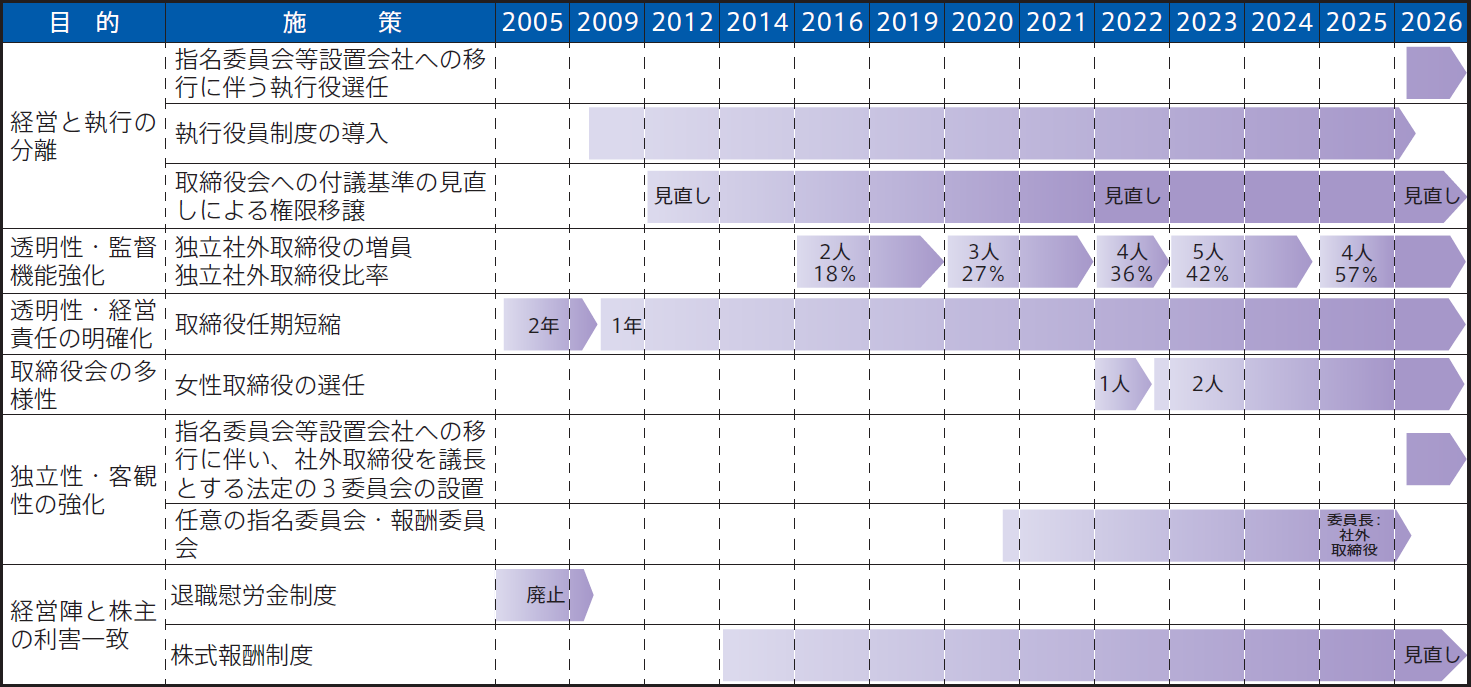
Recent initiatives
Transition to a company with a nominating committee, etc.
We transitioned from an Audit & Supervisory Board Company to a Company with Nominating Committee, etc. as of the conclusion of the 76th Annual General Meeting of Shareholders held on June 19, 2026. Except for important matters stipulated by laws and regulations and the Board of Directors Regulations, we promote the separation of management oversight and business execution by delegating decision-making authority for business execution to Executive Officers. In addition, we have appointed outside directors as the majority of the Board of Directors and the chairpersons of the Nominating, Compensation, and Audit Committees to further enhance the transparency and objectivity of management.
Strengthening of secretariat functions
for the Board of Directors and each committee
With the transition to a company with a nominating committee, we have established an administrative structure to support the nominating, compensation, and audit committees, in addition to the board of directors. To enhance the effectiveness of each committee, which is primarily composed of outside directors, we have assigned four directors to the nominating and compensation committees concurrently, and three directors to the audit committee full-time, thereby strengthening the operational foundation.
Reform of executive stock compensation system
With the transition to a company with a nominating committee, we have replaced the previous executive stock compensation system with a performance-linked restricted stock compensation system for Executive Officer. By using consolidated ROE and relative TSR as KPI and increasing the link between compensation and performance/share value, we have revised the compensation system to promote value sharing with shareholders and support the improvement of corporate value in the medium to long term.
Corporate Governance System
In June 2026, we transitioned from a company with a board of corporate auditors to a company with a nominating committee, etc. Therefore, in addition to the general meeting of shareholders, we have established a board of directors, a nominating committee, a compensation committee, an audit committee, Executive Officers, and accounting auditors as corporate organs. Furthermore, in order to ensure business execution that responds quickly to changes in the business environment, we delegate decision-making regarding business execution to Executive Officers as much as possible. At the same time, by appointing outside directors as the majority of the board of directors and the chairpersons of the nominating, compensation, and audit committees, we are striving to further improve the transparency and objectivity of management. The term of office for directors and Executive Officers is one year.
Diagram of the corporate governance system
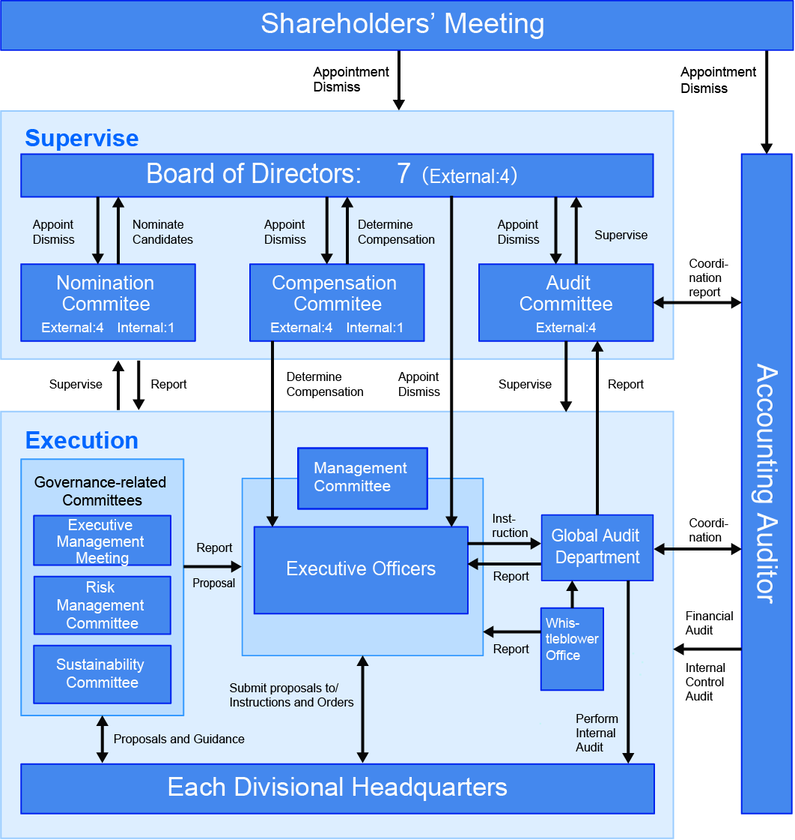
Overview of Major Committees and Meetings
Supervise
Nominating committee
The committee deliberates on policies for the appointment and dismissal of directors and Executive Officers, as well as succession plans, and is responsible for building the optimal management team through the selection and evaluation of candidates.
FY2025: Held 6 times (operated as a voluntary committee)
Compensation committee
The committee determines the compensation policies and individual compensation for directors and Executive Officers, as well as designing and reviewing performance-linked compensation and medium- to long-term incentive programs.
FY2025: Held 5 times (operated as a voluntary committee)
Audit Committee
The Audit Committee is composed solely of outside directors and audits the execution of duties by directors and Executive Officer, verifies the effectiveness of internal controls, and aims to improve the effectiveness of audits and overall governance of the group.
Business execution
Management meeting
The Management Meeting, composed of all Executive Officers, serves as the core body responsible for making decisions on business execution delegated by the Board of Directors. It deliberates and decides on important matters for the Group, aiming to expedite and improve the effectiveness of management.
FY2025: 25 meetings held (operated as a meeting body with the president, Executive Officers, and full-time auditors as attendees)
Business execution (specialized functions)
Risk Management Committee
The committee is chaired by the Human Resources Officer and consists of executive officers at the Executive Managing Officer level and above, as well as the audit committee secretariat. It is responsible for sharing risk information across the entire group, discussing response policies to serious quality issues, legal violations, cyberattacks, human rights risks, and promoting risk management.
FY2025: Held 4 times
Sustainability Meeting
Director, Representative Executive Officer, President (Chief Executive Officer) as the chairperson, and the committee is comprised of all Executive Officers (including those stationed overseas) and the Audit Committee Secretariat. It is responsible for promoting and managing sustainability activities and driving sustainability management.
FY2025: Held twice
Separation of supervision and execution
The role of the board of directors
In principle, the Board of Directors delegates decision-making authority over business execution to Executive Officers, except for matters stipulated by law and those defined in the Board Regulations as having a significant impact on the management of the Group. This system ensures that the Board of Directors are responsible for supervising management, while Executive Officers are responsible for the swift execution of business operations.
Business Execution system
We have established a Management Committee as the core body responsible for making decisions on business execution delegated by the Board of Directors to the Executive Officer. Composed of all Executive Officers, the Management Meeting deliberates and makes decisions on important matters of our group at meetings held twice a month in principle, thereby promoting swift and effective management.
The supervisory function of the board of directors
Composition of the Board of Directors
The Board of Directors consists of 7 directors, including 4 outside directors, and makes management decisions after thorough deliberation at regularly scheduled monthly meetings as well as extraordinary meetings held as necessary.
Activities of Board of Directors (FY2025)
In fiscal year 2025, we held 12 Board of Directors meetings to ensure swift decision-making and enrich discussions on important issues. Furthermore, under a structure in which independent outside directors constitute a majority, we strived to exercise our supervisory over management and ensure diversity in discussions. In addition, by appointing outside directors with specialized expertise, along with Executive Officers with in-depth knowledge of operations and those with experience as representatives of major subsidiaries, we ensured a balance of knowledge, experience, and capabilities across the entire Board of Directors, and facilitated multifaceted discussions on important matters.
Theme of the Board of Directors' Discussions (FY2025)
In fiscal year 2025, we continued to monitor the progress of Mid-to Long-Term Strategy, and with a view to transitioning to a company with a nominating committee, we held numerous discussions on enhancing our governance system from the perspective of strengthening the supervisory function of the board of directors and delegating authority to executives.
| theme | Main discussion points |
|---|---|
| Mid-to Long-Term Strategy Mid-Term Management Plan |
With a view to our 2030 targets, we discussed securing profitability, allocating management resources, and transforming our business portfolio in a situation where sales in our core businesses are declining while new businesses are being launched. |
| Profitability of core business | Amidst an anticipated decline in torque converter production volume, we discussed achieving fair pricing in our OEM business and maintaining and improving profitability through the expansion of our repair parts business. |
| growth investment new business |
We discussed growth investments through investments in VC funds, collaborative projects in new business areas, and M&A of startups, and confirmed the direction for building a new revenue base and transforming our business portfolio. |
| Financial Strategy Enhancing corporate value |
We discussed measures to improve ROE and enhance corporate value through management practices that are mindful of the cost of capital and stock price, such as balancing shareholder returns and growth investments, maintaining an optimal capital structure, and selling off strategically held shares. |
| Governance System | We have been working to improve the effectiveness of the optional Nominating Committee and Compensation Committee, and based on discussions in the Nominating Committee, we have reviewed the executive structure in preparation for transitioning to a company with a Nominating Committee. In addition, the Compensation Committee discussed improving the transparency of the compensation process and strengthening the link between executive compensation and the enhancement of corporate value. |
Assessment of Board of Directors' Effectivenss
We conduct a survey every year to evaluate the effectiveness of our Board of Directors. Through questionnaires and interviews with all directors and auditors, we understand the current state and challenges of the Board's operations and collect suggestions for improvement. The evaluation results and identified issues are reported and discussed at the Board of Directors meeting, and we are committed to continuous improvement.
Outline of the questionnaire survey to evaluate the effectiveness of the Board of Directors
- Survey target: All directors and auditors
- Frequency: Once a year
- Evaluation items: Composition and operation of the Board of directors, Support for outside directors, Delegation of authority and enhancing deliberations, and Status of discussions on corporate philosophy and business strategy.
Assessment Results (FY2025)
Based on the results of the survey and interviews conducted in April 2025, the Board of Directors reviewed the evaluation results and confirmed that our Board of Directors is functioning appropriately and its effectiveness is ensured. On the other hand, we identified the following points as challenges for further improving effectiveness.
- Review of the roles and functions of the board of directors
- Further revitalization of discussions regarding our company's future vision and Long-Term Vision
Improvement initiative based on assessmnet results (FY2025 results)
In response to the above challenges, the following initiatives were implemented in fiscal year 2025.
- The company is beginning to seriously consider transitioning to a company with a nominating committee.
- Strengthening the operational structure and functions of optional nominating and compensation committees.
- Expanding opportunities for dialogue between outside directors and Executive Officer
Future action plan (from fiscal year 2026 onwards)
In a survey and interviews conducted in April 2026, some respondents appreciated the expansion of opportunities for dialogue between outside directors and Executive Officers, and others suggested that the roles and functions of each committee should be further developed.
In light of our transition to a company with a Nominating Committee in June 2026, we will continue to work to improve the effectiveness of the Board of Directors by deepening discussions on Mid-to Long-Term Strategy within the Executive Officers and strengthening monitoring of Executive officers' work execution on important themes.
Nomination and Compensation Governance
Nominating committee
The Nominating Committee consists of 5 directors, including 4 outside directors, with an outside director serving as its chairperson. The Committee establishes policies and procedures for the appointment and dismissal of Directors and Executive Officers and is responsible for developing an optimal management structure aligned with the Company's management strategy and business characteristics. Utilizing tools such as the skills matrix and succession planning, the Committee identifies and evaluates candidates, helping to strengthen the management framework while enhancing the transparency and objectivity of the nomination process for Directors and Executive Officers.
Policies and procedures for the appointment and dismissal of directors and Executive Officer
In fiscal 2025, under the voluntary Nomination Committee (Chair: Independent Outside Director; Members: 4 Independent Outside Directors and 1 Internal Director), we undertook preparations for its transition to a Company with a Nominating Committee, etc. structure in June 2026. Specifically, the Committee identified candidates for Directors, Executive Officers, and members of each statutory committee (Nomination, Remuneration, and Audit Committees) under the new governance framework and submitted its recommendations to the Board of Directors. Based on these recommendations, the executive and governance structure for fiscal 2026 was determined. In addition, the Nomination Committee reviewed the entire nomination process, including defining the qualifications and competencies required of Directors and Executive Officers, reassessing the skills composition of the Board and management team, identifying candidate pools, and refining procedures for individual appointments and dismissals. The Committee also continued to identify high-potential future executive candidates and conducted interviews with candidates, which has contributed to enhancing succession planning and strengthening the nomination process. From fiscal 2026 onward, the Nomination Committee will continue to review the candidate selection process for Directors and Executive Officers. The Committee will continue to strengthen the management structure by updating succession plans from a medium- to long-term perspective and further enhancing the nomination process with a high degree of objectivity and transparency.
Compensation committee
The Compensation Committee consists of 5 Directors, including 4 Independent Outside Directors, and is chaired by an Independent Outside Director. In addition to formulating the basic policy on compensation for Directors and Executive Officers and determining individual compensation, the Committee continuously reviews the compensation system and performance evaluation metrics in light of our management strategy and changes in the business environment. In FY2026, the Committee reviewed both the bonus program and the performance-linked stock compensation plan.
Executive compensation
Basic Policy
At the Remuneration Committee meeting held on June 19, 2026, we resolved to adopt the policy for determining remuneration for Directors and Executive Officers. Our executive compensation policy is designed to function effectively as an incentive for the sustainable enhancement of corporate value. Accordingly, remuneration is linked to shareholder interests and is set at an appropriate level commensurate with the responsibilities of each Director and Executive Officer. Remuneration for Executive Officers responsible for business execution consists of base salary, bonuses, and performance-linked stock compensation. In contrast, Independent Outside Directors, who are responsible for supervisory functions, receive only base salary in consideration of the nature of their duties.
Reward mix
Executive Officers' compensation consists of base salary and bonuses paid in cash as short-term incentives, together with performance-linked stock compensation designed to promote sustainable growth in corporate value and strengthen alignment with shareholder interests over the medium to long term. With regard to cash compensation, approximately 80% of the annual cash remuneration is composed of fixed monthly salary, while approximately 20% is allocated as the target bonus amount.
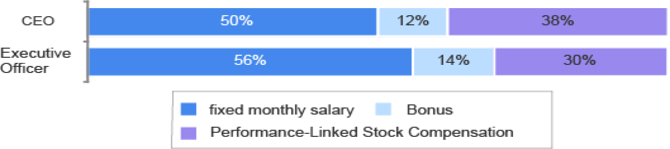
- Illustrative percentages based on the achievement of 100% of fiscal 2026 performance targets.
- The remuneration structure is designed so that the proportion of performance-linked stock compensation as a percentage of total remuneration increases according to executive rank.
Bonuses
At a Compensation Committee meeting held on June 19, 2026, we revised the method for determining bonuses. Bonuses are calculated based on the achievement of common KPIs and individual KPIs set according to position and responsibilities, with the aim of encouraging contributions to short-term performance improvement and the enhancement of corporate value. The weight of individual KPIs is determined by the Compensation Committee within a range of 0% to 50%, depending on the position of each Executive Officer, while the weight of common KPIs is calculated by subtracting the individual KPI weight from 100%. This allows bonuses to reflect both the Group's overall performance targets and the results achieved in each Executive Officer's area of responsibility. The common KPIs are consolidated ROE, consolidated operating profit, and the Net GHG reduction rate. Depending on the level of achievement of each KPI, the payout rate against the target bonus amount ranges from 0% to 120%.
Bonus KPIs and weightings
| KPI classification | KPI | Weight in Bonus Calculation | Target (FY2026) | Payout Rate |
|---|---|---|---|---|
| Common KPIs | Consolidated ROE | Common KPI weight × 50% | 7.5% | 0~120% |
| Consolidated operating profit | Common KPI weight × 35% | ¥24.5 billion | 0~120% | |
| Net GHG reduction rate (Scope1+2) | Common KPI weight × 15% | 16.8% reduction vs. FY2022 | 0~120% | |
| Individual KPIs | Individually established for each Executive Officer | 0-50% (determined according to position) | Set according to position and responsibilities | 0~120% |
| Total | - | 100% | - | - |
- The weighting for the common KPIs is calculated as 100% minus the weighting assigned to the individual KPIs.
Performance-Linked Stock Compensation
At a meeting of the Compensation Committee held on June 19, 2026, we resolved to introduce a performance-linked restricted stock compensation plan settled following the performance period for Executive Officers, replacing the conventional restricted stock compensation plan. The purpose of this plan is to promote greater alignment of interests between executives and shareholders, while strengthening the linkage between executive compensation, Company performance, and shareholder value, thereby providing incentives for the sustainable enhancement of corporate value over the medium to long term. The performance evaluation period is one year, and shares are granted following the completion of the evaluation period based on the achievement level of the performance indicators.
Stock Compensation KPIs and Weighting
| KPI | Target (FY2026) | Weighting | Payout Rate |
|---|---|---|---|
| Consolidated ROE | 7.5% | 50% | 0~120% |
| Relative TSR | 100% | 50% | |
| Total | - | 100% |
Shares granted under this plan are subject to a 30-year transfer restriction period. Through the promotion of long-term share ownership by executives, the plan is designed to strengthen the alignment of interests with shareholders and enhance commitment to the sustainable growth of corporate value. Transfer restrictions are lifted upon the expiration of the restriction period or in cases of death or retirement for legitimate reasons.
Malus and Clawback Provisions
Under the performance-linked stock compensation plan, we may acquire, without consideration, restricted shares granted as compensation in cases where an executive has committed a material violation of applicable laws, regulations, or internal rules, retired without legitimate reason, engaged in activities that compete with the EXEDY Group, or otherwise met the conditions specified by us.
Audit System
Audit system and activities of the Board of Corporate Auditors (FY2025)
Audit System
Our company transitioned from a company with a board of corporate auditors to a company with a nominating committee, etc., at the ordinary general meeting of shareholders held on June 19, 2026. In fiscal year 2025, under a system of three members consisting of one full-time corporate auditor and two outside corporate auditors, including a certified public accountant, we strived to ensure the soundness and transparency of management through audit activities centered on the board of corporate auditors, in cooperation with the global audit department (internal audit department) and the accounting auditors. In addition, we aimed to improve the effectiveness of audits through monthly meetings of the board of corporate auditors, as well as regular information sharing and exchange of opinions with the full-time corporate auditor, the global audit department, and the accounting auditors.
Main activities of the Board of Corporate Auditors
The Board of Corporate Auditors has not only conducted legality audits and preventive audits to establish a corporate governance system that earns social trust, but has also raised issues and provided advice on new business risks arising from the implementation of the values that the company cherishes in its business activities and the transformation of its business portfolio. In addition, the Board of Corporate Auditors strives to ensure the effectiveness of audits throughout the group by having full-time and outside corporate auditors conduct on-site inspections, holding corporate auditor liaison meetings with corporate auditors of domestic affiliated companies to share the status and challenges of audits at each company, and coordinating with the internal audit department. Furthermore, the Board of Corporate Auditors continues to hold corporate auditor liaison meetings every two months with the corporate auditors of Dynax, the largest subsidiary of the Group.
Main topics and number of agendas discussed at the Board of Corporate Auditors meeting in FY2025
| Category | number |
|---|---|
| Audit Activity Report | 18 |
| Accounting audit | 8 |
| Internal control system audit | 8 |
| Audit policy and plan | 3 |
| Company management status | 2 |
| Individual projects | 8 |
| grand total | 47 |
FY2024 Audit & Supervisory Board / Auditors Performance
| Board of Auditors | 16 times |
| Attending important meetings such as the Board of Directors (Board of Directors Meeting, Management Meeting, Executive GD*,* Sustainability Meeting, etc.) |
116th time |
| Visiting group companies (4 overseas, 7 domestic) | 22 times |
- Executive Group Discussion: A meeting for intensive discussion of management issues among executives
FY2024 Audit Cooperation Status
| Cooperation with accounting auditors | 6th |
| Collaboration with the Internal Audit Department (Sharing of audit results and issues for our company and the group, exchanging opinions on issues in business operations, etc.) |
6th |
| Liaison Meeting of Auditors of Domestic Affiliated Companies | 1 time |
Internal Audit Department
Based on our group's management policies and key risks, the Global Audit Department conducts risk assessments annually, formulates audit themes and plans, and performs operational audits of each department and group company. In addition, it conducts ad-hoc audits as needed, striving to enhance audits to ensure internal controls.
Audit Committee
After transitioning to a company with a nominating committee, etc., in June 2026, the audit committee, composed of four independent outside directors, took over its supervisory functions. In addition, an Audit committee secretariat has been established, and three full-time employees have been assigned to assist the audit committee in its duties to enhance the effectiveness of its audits. Furthermore, the framework established by fiscal year 2025 for collaboration with the global audit department and accounting auditors will be maintained and developed to continue improving the effectiveness of the supervisory system.
Supervisory function of outside directors
Criteria for appointing independent outside directors
In appointing independent outside directors, our company places importance not only on the requirements for outsideness under the Companies Act, but also on extensive experience and high level of expertise in their respective fields. Our criteria for designating an independent outside director include meeting the qualifications for independent officers as defined by the financial instruments exchanges and ensuring there is no risk of conflict of interest with general shareholders. In fiscal year 2026, the Nominating Committee will further discuss the independence criteria.
Exercise of Supervisory function by outside directors (FY2025)
In fiscal year 2025, the outside directors played an independent oversight role in the Board of Directors, where outside directors constitute a majority, as well as in the optional Nominating Committee and Compensation Committee. the outside directors provided advice and supervision on important themes such as Mid-to Long-Term Strategy, financial and capital policies, and human resource strategies, and worked to enrich discussions and improve the objectivity of decision-making through prior briefings before Board meetings.
Attendance at Board of Directors meetings and various committee meetings (FY2025)
| Board of directors | Board of Auditors | Nominating committee | Compensation committee | |||||
|---|---|---|---|---|---|---|---|---|
| Director | President and CEO | Tetsuya Yoshinaga | Male | ◎ 12/12 | ○ 6/6 | ○ 5/5 | ||
| Representative Director | Hiroshi Toyohara | Male | ○ 12/12 | |||||
| Director | Yuzuru Hirose | Male | ○ 12/12 | |||||
| Director | Toshiki Takano | Male | [External] / [Independent] | ○ 12/12 | ○ 6/6 | ○ 5/5 | ||
| Director | Takashi Hayashi | Male | [External] / [Independent] | ○ 12/12 | ◎ 6/6 | ○ 5/5 | ||
| Director | Fukuko Inoue | Female | [External] / [Independent] | ○ 12/12 | ○ 5/6 | ◎ 5/5 | ||
| Director | Kimiko Ito | Female | [External] / [Independent] | ○ 12/12 | ○ 6/6 | ○ 5/5 | ||
| Audit & Supervisory Board Member | Full-time auditor | Takashi Suzuki | Male | ○ 12/12 | ◎ 16/16 | |||
| Audit & Supervisory Board Member | Tadashi Fukuda | Male | [External] / [Independent] | ○ 10/12 | ○ 13/16 | |||
| Audit & Supervisory Board Member | Satoshi Tsubota | Male | [External] / [Independent] | ○ 12/12 | ○ 16/16 | |||
- ◎ Chairperson / Chairman 〇 Attending Members
- This applies to directors who are in office as of March 31, 2026.
Protection of shareholder interests
Cross-Shareholdings
Policy on Cross-Shareholdings
In principle, we do not hold listed shares as "cross-shareholdings," except when it is necessary to maintain and strengthen trust and business relationships with business partners and various stakeholders from the viewpoint of improving our Group's corporate value in the mid- to long-term.
Verification of Cross-Shareholdings
The Board of Directors evaluates each cross-shareholding, including whether the risks and benefits exceed the cost of capital.
Voting Guidelines for Policy-Held Shares
While we do not currently hold any listed shares as cross-shareholdings, if we were to hold any in the future, we would exercise our voting rights from the perspective of enhancing the corporate value of our group, rather than based on uniform criteria. In particular, we will carefully consider and make comprehensive decisions regarding the proposals listed below.
- Reorganization Proposal
- Takeover Defense Proposal
- Appointment of Directors Proposal (in the event of misconduct, in the event of being in the red for a certain period of time in a row,etc.)
Cross-Shareholdings (Year Ended March 31,2026)
| Number of brands Balance sheet amount (million yen) |
|||
|---|---|---|---|
| In fiscal year 2025 Stocks with an increased number of shares |
In fiscal year 2025 Stocks whose number of shares has decreased |
||
| Unlisted shares |
13 436 |
2 301 |
- - |
| Listed stocks |
- - |
- - |
8 1,659 |
- The stocks whose number of shares increased in fiscal year 2025 were mainly due to investments in startup companies aimed at creating new businesses.
Transactions between Related Parties
Following the Companies Act, EXEDY has established in the Regulations of the Board of Directors that any self-dealing or conflict-of-interest transactions with the company's directors are subject to prior approval. In addition, the conditions of transactions are determined through negotiations, considering the market conditions, as is the case with other third parties. Please note that there will be no related-party transactions in fiscal year 2025.