
TCFD-Aligned Disclosures Disclosures in accordance with the recommendations of the Task Force on Climate-related Financial Disclosures
Our group is committed to addressing global warming, a challenge facing the international community, with the goal of achieving carbon neutrality (net-zero greenhouse gas emissions) by 2050. To achieve this goal, we are promoting energy conservation initiatives, introducing renewable energy, and developing next-generation electrified products and products for the future. We have also expressed our support for the Paris Agreement and the recommendations of the Task Force on Climate-related Financial Disclosures (TCFD). Based on multiple scenarios, we analyze the impacts of climate change on our business and the associated risks and opportunities. The results of these analyses are reflected in our management strategies and financial plans to enhance the resilience of our strategies (our ability to adapt to changing conditions).
Governance
Our group recognizes climate change as one of our important management challenges, and after deliberation at management meetings and on the board of directors, we have positioned contributing to the realization of a decarbonized society as one of Long-Term Vision. Furthermore, in order to realize this vision, we have set climate-related KPIs (Key Performance Indicators) and are incorporating them into our management practices.
Supervision by the Board of Directors
The Board of Directors receives regular reports from the Management Committee and the Sustainability Committee on important sustainability matters, including climate change, and oversees strategies, KPIs, targets, and their progress, taking into account the impact of climate-related risks and opportunities on business strategies and financial plans. Furthermore, the Board of Directors deliberates and makes decisions on matters in which climate change is judged to have a significant impact on the group's business strategies and finances in the medium to long term, ensuring that these decisions are reflected in management decisions. In addition, we position sustainable growth and the transition to a decarbonized society as important management issues, and in order to clarify the involvement and responsibility of management, we have introduced "GHG (greenhouse gas) emission reduction rate" as a KPI for executive compensation, linking the achievement of climate-related targets to compensation.
Climate-related governance, centered around sustainability conferences
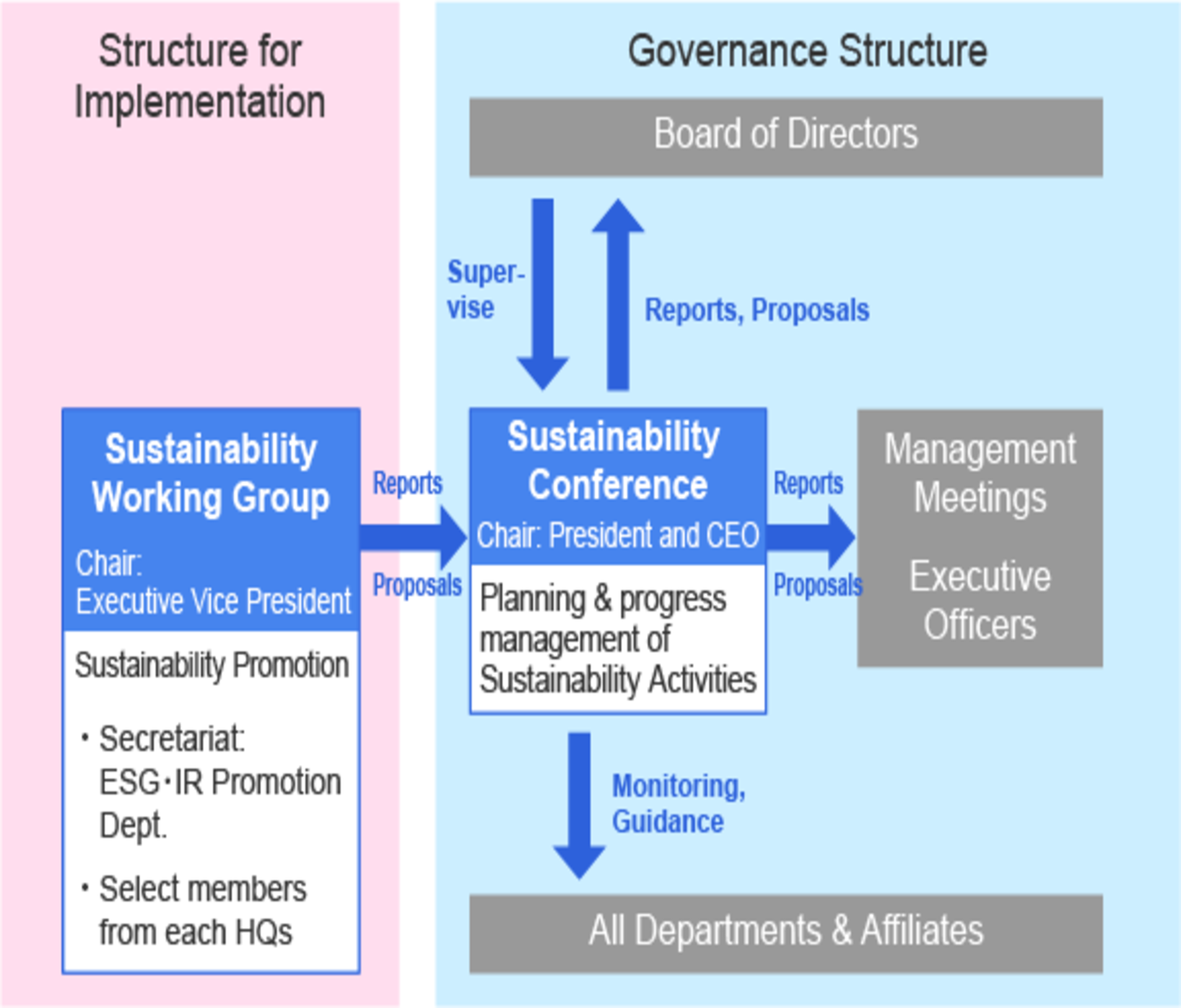
To promote sustainability activities, including climate change initiatives, and monitor their progress, we have established the “Sustainability Committee” directly under the Board of Directors. The committee is chaired by Director, Representative Executive Officer, President (Chief Executive Officer), and is attended by all Executive Officer (including those stationed overseas) and the Audit Committee Secretariat. It meets twice a year. The Sustainability Committee formulates KPIs and medium- to long-term targets related to climate change, considers appropriate responses based on stakeholder requests, and monitors progress and issues. Matters deemed to have a significant impact on business operations are submitted to and reported to the Management Meeting and the Board of Directors.
Implementation structure
We have established a "Sustainability Working Group" to implement sustainability activities and promote them company-wide.
The group's Sustainability Working Group is chaired by Director, Representative Executive Officer, Executive Vice President and consists of members selected from each headquarters. It is responsible for the specific consideration and implementation of sustainability activities, including response to climate change. The results of the working group's deliberations and activities are regularly reported to the Sustainability Conference, and this information is reflected in the management team's monitoring and decision-making processes..
strategy
A. Scenario assumptions
To understand the potential financial impact of climate change on our group's business and to identify climate-related risks and opportunities, we referenced external scenarios such as the International Energy Agency (IEA) World Energy Outlook and the 2° Investing Initiative as benchmarks. We also reviewed scenario analyses related to the automotive industry and, while comparing them with our own long-term business environment perception, comprehensively considered scenarios. We then identified climate-related risks and opportunities through gap analysis between the scenarios and our own long-term strategy. The scenarios were defined based on an analysis of all our global businesses, and were classified along two axes: transition risk and physical risk, using IEA NZE, IEA STEPS, and the 4° scenario (a case where climate change countermeasures do not progress significantly).
| parameter | CY2024 | STEPS 2.5℃ | NZE 1.5℃ | source | ||
|---|---|---|---|---|---|---|
| Transition Risk | Carbon Price | carbon price (US$/t-CO2) |
– |
EU
CY2035
89
CY2040
92
CY2050
174
|
developed countries
CY2035
180
CY2040
205
CY2050
250
|
IEA「WEO 2025」※5 |
| Changes in the energy mix | Electricity charges ①Coal ②Solar light (US$/MWh) |
– |
USA
①
②
CY2024
100
55
CY2030
120
35
CY2050
190
25
|
USA
①
②
CY2024
210
55
CY2030
na
30
CY2050
na
25
|
||
| CO2 conversion factor (t-CO2/MWh) |
0.446 |
CY2035
0.251
CY2040
0.187
CY2050
0.122
|
CY2035
0.072
CY2040
0.005
CY2050
-0.004
|
|||
| raw materials | Grade iron price ① Conventional construction method ② Groundbreaking method ($/t) |
CY2024 ① 470-570 ② n.a. |
CY2035 ① 450-530 ② 710-850 CY2050 ① 450-530 ② 690-840 |
CY2035 ① 560-780 ② 700-810 CY2050 ① 690-810 ② 700-850 |
||
| Changes in customer behavior | EV sales | CY2024 20% |
CY2035 55% * In China, 90% by 2035; in the EU, 80%. |
CY2035 No disclosure |
||
| parameter | CY2016 | 4℃※3 | 2℃(1.5℃)※4 | source | ||
|---|---|---|---|---|---|---|
| Transition Risk | Changes in customer behavior | Gasoline, Diesel vehicles Sales figures |
Current situation (=100%) | CY2050 100% of the current situation LCT*1 |
CY2050 A 90% reduction from the current level. ACT*2 |
2Dii “The Transition Risk-o-Meter Reference Scenarios for Financial Analysis” *6 |
| Physical Risks | Rising average temperature | Air conditioning costs (US$/person/year) |
about 19 | CY2030 approx. 30 CY2050 approx. 60 |
CY2030 approx. 30 CY2050 approx. 35 |
IEA "The Future of Cooling" |
| Intensification of extreme weather events | Flood frequency | CY2018 (=100%) | CY2040 400% | CY2040 200% | Ministry of Land, Infrastructure, Transport and Tourism "Recommendations on Flood Control Planning in Consideration of Climate Change" 2019 |
|
| Typhoons and cyclones occurrence |
26 occurrences per year | The frequency may decrease, but the power may increase. | Japan Meteorological Agency / Ministry of the Environment | |||
- Limited Climate Transition
- Ambitious Climate Transition
- Cases where climate change countermeasures do not progress well
- Scenarios in which climate change countermeasures are accelerated (partially the 1.5°C scenario)
- International Energy Agency “World Energy Outlook”
- 2D Investing Initiative
B. Identifying climate-related risks and opportunities
opportunity
| Important items | Potential Financial Impact | Time axis / Influence | Correspondence | |
|---|---|---|---|---|
| Main Opportunities | Development and expansion of low-emission products |
Increased sales revenue from new products that meet the growing need for improved power transmission efficiency in response to electrification and decarbonization.
|
Medium-term/High |
Currently, we are focusing on the following 3 businesses while simultaneously exploring opportunities to create further new businesses.
|
| Development of new products through research and development and technological innovation |
Increased sales revenue from products that meet the needs for advanced business activities through improved energy efficiency, labor savings, and electrification.
~Business related to UAVs, infrastructure, and plant solutions |
Medium-term/High |
Currently, we are focusing on the following 3 businesses while simultaneously exploring opportunities to create further new businesses.
|
|
| Utilizing more efficient production and logistics processes |
Reduced energy costs through more efficient production. ~ Long-Term Vision /One of the measures to reduce greenhouse gas emissions is energy conservation activities to reduce emissions by 1% per year (11% by 2030). |
Medium-term/High |
Through the above activities, we achieved a cost reduction of 560 million yen per year in fiscal year 2024. |
- This disclosure is based on a scenario analysis as of February 2026. For the latest new business sales plan, please refer to the financial results briefing materials published in April 2026.
risk
| Important items | Potential Financial Impact | Time axis / Influence | Correspondence | |
|---|---|---|---|---|
| Main Opportunities | <Transition Risks> Stricter regulations on existing products and market changes |
Sales decline due to decreased sales of internal combustion engine vehicles and decreased demand for parts for internal combustion engines. Under scenario 2ii, internal combustion engine sales are projected to decrease by 90% in fiscal year 2050.
Internal combustion engines account for 89% of EXEDY Group's sales, and the impact on sales in fiscal year 2050 is estimated to be approximately -250 billion yen. |
Medium-term/High |
We will improve Earning Power of our core businesses, concentrate management resources on creating new businesses, and transform our business portfolio.
Core Business Plan for Fiscal Year 2030
New Business Plan for Fiscal Year 2030 |
| <Transition Risks> Government strengthens regulations on greenhouse gas emissions |
Reduction of direct emissions through the introduction of renewable energy ~If energy conservation activities proceed as planned |
Medium-term/High |
|
|
| <Physical Risks> Intensification and increased frequency of extreme weather events such as cyclones and floods. |
Sales decline due to factory shutdowns and supply chain disruptions. According to the Ministry of Land, Infrastructure, Transport and Tourism's "Recommendations on the Ideal Form of Flood Control Planning in Light of Climate Change," the frequency of flood occurrences is projected to double (2°C) to quadruple (4°C) by 2040. If operations are suspended (for 5 days) in Japan and Asia (69% of total production), where there is a high possibility of flooding, the impact on sales will be -4.14 billion yen. |
Medium-term/High |
|
Examples of responses to physical risks
Our group is assessing the risks of natural disasters such as typhoons and heavy rains, which have become increasingly severe in recent years due to the effects of climate change, and is taking measures according to the risk situation at each business location.
Risk assessment for each business location
We conduct risk assessments at each business location using hazard maps and information on recent natural disasters. Based on the results, we identify areas requiring action and determine appropriate measures according to the risk level of each location. We then implement these measures in accordance with the established action plans.
Countermeasures Examples
- The entire facility is at high risk
·transfer
EXEDY Kiko Co., Ltd. (previously EXEDY Kyoto Co., Ltd.) is a business office located near the Kizugawa River and is at high risk of flooding and inundation damage, so in fiscal 2020 it relocated to Tenri City, Nara Prefecture.
・Flood prevention measures for the entire facility
In light of the flood damage caused to the area by Typhoon Hagibis in October 2019, the Kawagoe Plant implemented flood prevention measures for the entire facility.
- Flood prevention measures for the entire facility (construction of flood-prevention basins, construction of block walls, etc.)
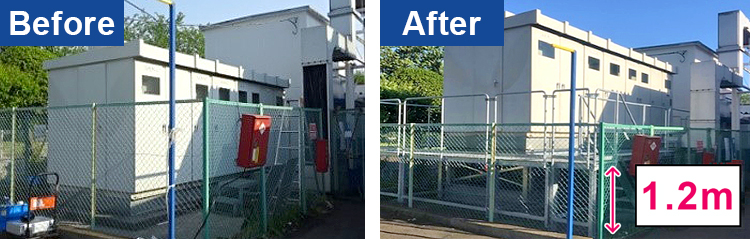
- Measures to prevent flooding of important facilities (raising substations, installing waterstops and doors, etc.)
Flood control measures for the Kawagoe factory and business premises
(Construction of a block wall around the perimeter)
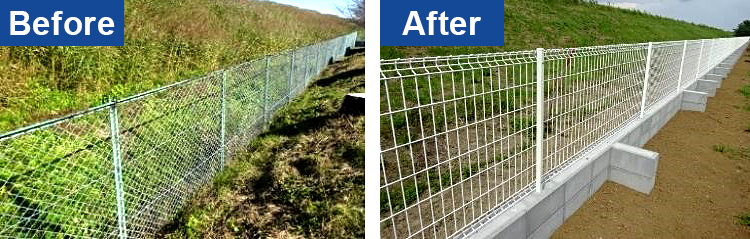
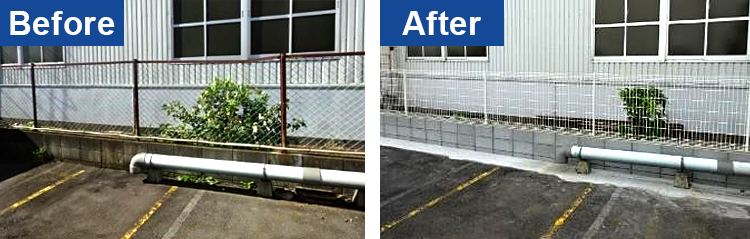
Flood prevention measures for facilities at Kawagoe Factory
- The entire facility is at high risk
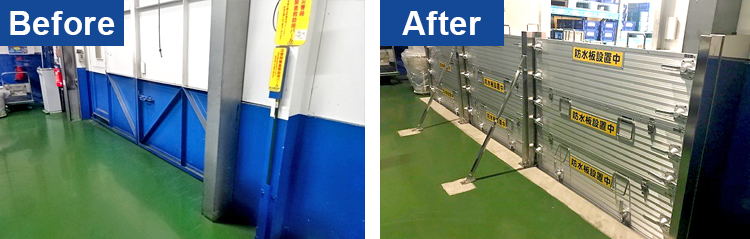
At our head office factory, we determine risk locations by taking into consideration elevation differences, piping, and drainage capacity within the site, and then take the following measures.
- Measures for high-risk areas within the workplace
- Installation of drainage pump at the meeting hall
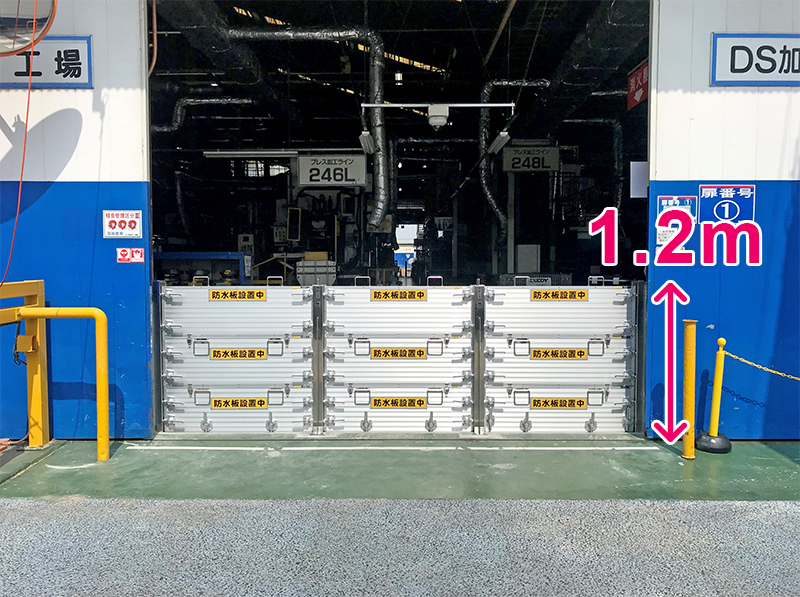
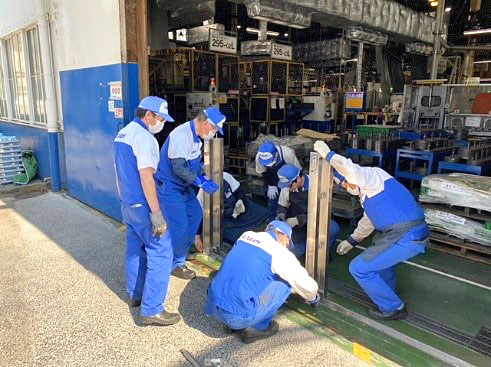
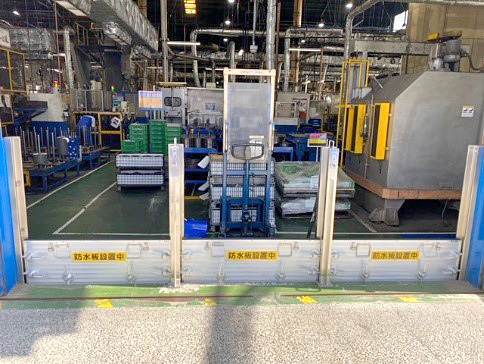
- Installation of water gates at the entrances of business establishments and factories and installation training
- Deployment of watertight barriers to oil storage facilities and emergency installation training.
Flood and drainage countermeasures in the head office factory
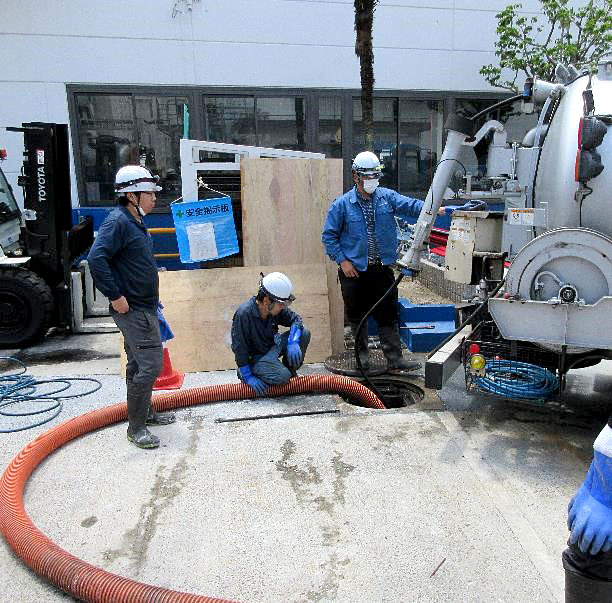
Drain cleaning pipe
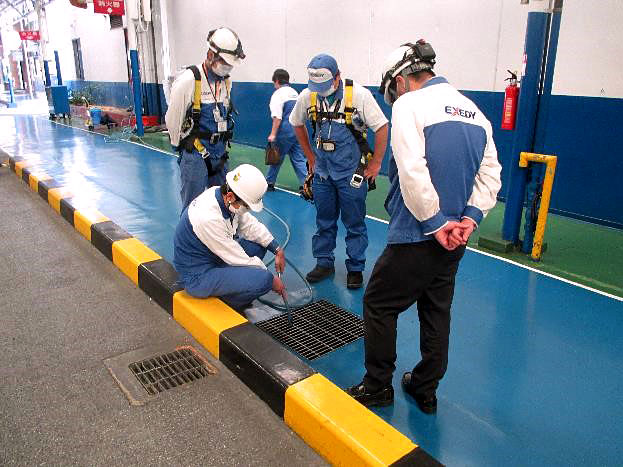
Check the installation of drainage pumps at the meeting place
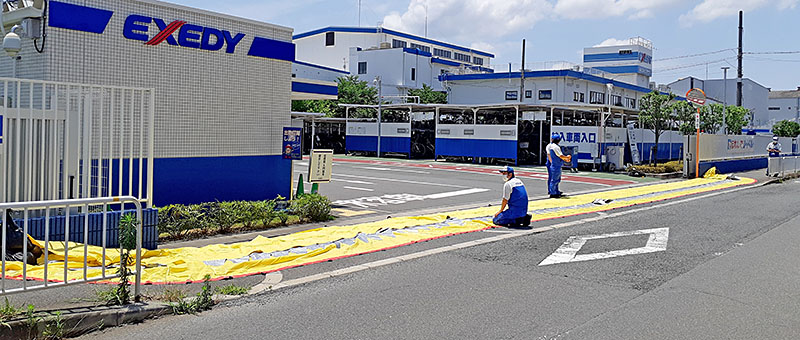
Watergate installation training
Installation of waterstops at oil storage facilities (DS factory) and emergency installation training
C. Impact on business strategy
Through the identification of the aforementioned climate-related risks and opportunities, our group recognizes the accelerating global transition to carbon neutrality, the growing shift toward BEVs (battery electric vehicles), and the medium- to long-term contraction of the market for internal combustion engine vehicles as significant changes in the business environment. Considering the impact of these changes on our business strategy and financial performance, and following ongoing discussions at the Management Meeting and the Board of Directors, we formulated and announced our Mid-to Long-Term Strategy and Mid-Term Management Plan, "Transformation/REVOLUTION2026," in April 2024.
Medium- to Mid-to Long-Term Strategy (Strategy for FY2030)
Mid-to Long-Term Strategy consists of three pillars: business strategy, financial strategy, and ESG strategy. The core of the business strategy for fiscal year 2030 is a transformation of the business portfolio.
Specifically, our policy is to improve profitability in our current businesses while simultaneously allocating human resources and capital to creating new businesses in promising growth areas, thereby responding to changes in market structure brought about by climate change.
Our business strategy targets for fiscal year 2030 are a 10% return on equity (ROE), 330 billion yen in sales, 30 billion yen in operating profit, and a 30% ratio of new product sales. We aim for sustainable growth through a transformation of our business portfolio.
Mid-Term Management Plan "Transformation/ REVOLUTION2026"
Mid-Term Management Plan, "Transformation/ REVOLUTION2026," is a 3-year plan covering the period up to fiscal year 2026, with a view to the state of affairs in fiscal year 2030. It is positioned as a phase in which we will advance the transformation of our business timeline, approach methods, and business model. The core of the business strategy in this plan is:
- Achieving the optimal capital structure
- Improving the profitability of core businesses
- Creation and development of new businesses
These are the 3 key points. In particular, with regard to ③ Creating and Developing New Businesses, we are strengthening our R&D and new business development capabilities to accelerate our response to medium- to long-term changes in the business environment, including climate change. These initiatives include adopting a project-based approach, establishing R&D centers in India and the UK, increasing staff at our Silicon Valley office, establishing a dedicated M&A department, and creating new departments to promote the creation and development of new businesses.
Linkage with ESG strategy
In our ESG strategy, we position sustainability activities, including response to climate change, as important management issues, and aim to enhance corporate value through improved evaluations from external rating agencies. To promote this, we established the ESG/IR Promotion Department in April 2024 to advance the formulation and promotion of our ESG strategy and expand information disclosure.
D. Impact on financial plans
In implementing our Mid-to Long-Term Strategy, which takes climate-related risks and opportunities into account, our group recognizes the following as key issues that will have a major impact on our financial plan: (1) achieving an optimal capital structure, (2) improving the profitability of our core businesses, and (3) creating and developing new businesses.
All of these matters are discussed and decided upon by the management committee and the board of directors, and then implemented.
Impact of structural reforms in core businesses
As the market for internal combustion engine vehicles shrinks due to the advancement of BEVs, the torque converter business in Japan and China is expected to contract rapidly in the medium to long term. In light of these changes in the business environment, an impairment test was conducted in the FY2023 financial statements, and an impairment loss of 31.9 billion yen was recorded for business assets related to torque converters in the AT business. This measure aims to reduce the depreciation burden in the AT business from FY2024 onward.
In addition, we are optimizing our production system by liquidating our unprofitable U.S. subsidiary (EXEDY America) and streamlining our workforce at our Chinese base. Furthermore, in light of the changes in cost structure due to climate change, we are working to mitigate the impact on profitability by establishing appropriate prices through negotiations with our business partners, thereby ensuring the stability of our financial foundation in the medium to long term as we transform our business portfolio.
Impact on growth investments and capital allocation
To create and nurture new businesses, we use the ratio of new product sales as a KPI in addition to the ratio of research and development expenses. The target levels are 30% in FY2030, 86% in FY2040, and 94% in FY2050, and are positioned as indicators to quantitatively manage the transformation of our business portfolio in response to changes in market structure due to climate change.
Based on these KPIs, we plan to allocate 30 billion yen as growth investments in our capital allocation from fiscal year 2024 to 2026.
Specifically, we will make flexible capital investments through M&A as a strategic investment, and we will focus on allocating human resources and funds to the new product development area as an R&D investment.
Regarding M&A, since April 2023, we have invested a total of 9.17 billion yen* in 16 startups and other companies that possess the knowledge necessary for future business development, such as motor and drone-related technologies, and are also promoting the creation and nurturing of new businesses through personnel dispatch. (*Results as of the end of December 2025)
Furthermore, to further strengthen our new business creation activities, we introduced a project system in April 2024. In addition, in April 2025, we established the "Strategic Business Headquarters," consolidating resources that had been dispersed across various organizations, and creating three new business-related departments, including a department dedicated to M&A. This has created a system that allows us to promote everything from business exploration and investment decisions to commercialization and nurturing in a seamless manner, thereby accelerating the creation and growth of new businesses.
Risk Management
At EXEDY Group, our basic risk management guiding principle is to implement proactive measures and preparations to prevent emergencies and minimize damage.
Based on this policy, we evaluate and identify risks based on their frequency and impact, as well as the external environment surrounding our business, and implement company-wide risk management.
In safety, health, and environmental protection activities, as well as business continuity management activities, we identify key risk items and, for each risk, clarify the responsible department, impact, causes, preventive measures, and response policies, thereby strengthening our management system.
Identifying, assessing, and managing climate-related risks
Regarding climate-related risks, we identify and assess risks using scenario analysis, primarily through our Sustainability Conference, and manage the progress of countermeasures. The identified and assessed climate-related risks are integrated into the company-wide risk management process, just like other business risks, and are discussed and managed in appropriate governing bodies according to their significance.
The main climate-related risks and the current response are as follows:
Transition risks (market and technological changes)
The risk of declining sales due to changes in demand resulting from the discontinuation of sales of internal combustion engine vehicles is continuously discussed at Management Meetings and Board of Directors meetings.
Based on these results, we are working to adapt to the transformation of our business structure by formulating our Long-Term Vision and strengthening our product and technology development capabilities.
Transition risks (regulations and policies)
Regarding the risk of increased direct costs associated with the introduction of renewable energy due to stricter government regulations, the Sustainability Working Group is gathering information on renewable energy options and the latest trends, and is conducting research and studies on introduction methods and cost reduction measures.
Physical risks (natural disasters)
Regarding the risk of supply chain disruptions due to natural disasters such as floods, the Risk Management Committee, composed of Director, Representative Executive Officer, President (Chief Executive Officer) Director, Representative Executive Officer, Executive Vice President, executive officers at the Executive Officer level and above, and the Audit Committee Secretariat, is reviewing and promoting business continuity plans (BCPs) that include suppliers.
Indicators and goals
The EXEDY Group is working toward achieving carbon neutrality by 2050. We have established the “GHG (greenhouse gas) emissions reduction rate” as a climate-related KPI, set the following targets, and regularly review progress at Sustainability Conferences.
* Long-term goals will be reviewed in April 2026.
| Indexes | GHG emission reduction rate Scope 1 (direct emissions) + 2 (indirect emissions: electricity, etc.) Scope 3 Cat.1 (Indirect discharge other than Scope 2) |
|---|---|
| Goal | Scope1+2 <Compared to FY2022 * > ▲4.2%/year Target year 2030 (▲33.6%) / 2035 (▲54.6%) / 2050 (▲100%) Scope3 Cat.1 <Compared to FY2025 * > Target year 2035 (▲ 25%) / 2050 (CN) |
| Actual (FY2025) | Projected reduction rate (Scope 1+2): -25.1% <compared to FY2022> (Scope3 Cat.1) Setting of reference values Emissions (by Scope) Scope 1: 26.2 thousand t-CO2 Scope 2: 121.4 thousand t-CO2 Scope 3: 1395.5 thousand t-CO2 |
As described above, EXEDY Group recognizes climate change as one of its important management challenges and, under a governance system centered on the Board of Directors and the Sustainability Committee, sets KPIs, including GHG emission reductions, and promotes sustainability activities. In addition, it conducts analyses based on multiple climate scenarios to identify climate-related risks and opportunities, and to evaluate the potential financial impact on its business. The results are reflected in Long-Term Vision, Mid-Term Management Plan, and financial plan, and it is working to address the transition to a decarbonized society and natural disaster risks. Moving forward, the Exedy Group aims to strengthen the resilience of its business and achieve sustainable corporate value enhancement through transformation of its business portfolio, reduction of greenhouse gas emissions, and improvement of emissions management in its supply chain.