
Human Rights
Basic Approach
Our approach to respecting human rights
Respect for human rights is fundamental to our business activities, and we recognize that a deep understanding of and appropriate response to human rights issues related to the countries in which we operate and our business activities are required of us.
EXEDY Group Human Rights Policy
Our company has formulated the "EXEDY Group Human Rights Policy" after deliberation and approval by the management committee. Based on the United Nations Guiding Principles on Business and Human Rights (UNGPs), this human rights policy is established to ensure that our group, which operates globally, respects internationally recognized human rights and thoroughly complies with the relevant laws and regulations of the countries in which we operate. It is positioned as our highest-level policy regarding human rights in our business activities.
Governance Structure
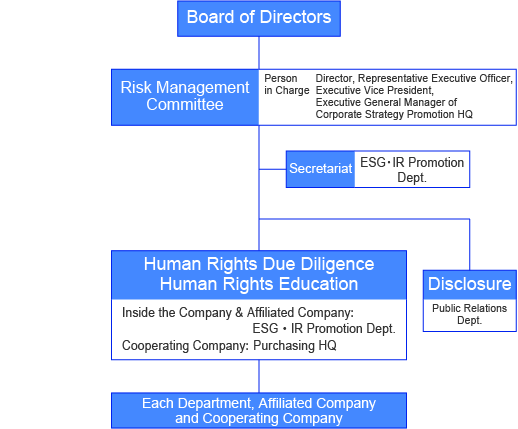
Our company has established a Risk Management Committee as a subordinate committee of the Board of Directors, and has entrusted this committee with the responsibility of overseeing serious matters, including human rights and compliance. The committee is comprised of members of the management team, with the Representative Executive Officer, Vice President and Head of the Corporate Strategy Promotion Headquarters serving as the chief officer for risk management. In accordance with the human rights policy, the committee receives and deliberates on reports regarding the implementation status of human rights due diligence, the results of human rights risk assessments, and the progress of corrective measures. The committee also meets at least twice a year, and the matters deliberated and decided are regularly reported to the Board of Directors. Based on these reports, the Board of Directors oversees all initiatives related to human rights and business ethics/compliance. In practical terms, the ESG/IR Promotion Department is the department in charge, and works in cooperation with relevant departments to promote these measures.
Initiatives
Human Rights Due Diligence
Based on EXEDY Group Human Rights Policy, we are committed to human rights due diligence to identify, prevent, and mitigate negative impacts on human rights. Against a backdrop of increasing legal regulations and social demands to protect the rights of migrant workers worldwide, public concern regarding foreign technical trainees is also growing in Japan. Furthermore, these issues are recognized as important human rights issues by stakeholders, including shareholders and customers. Given this background, we have positioned "foreign technical trainees" in Japan as a human rights risk that requires focused monitoring and management. In addition, we have strived to identify human rights risks through internal system surveys related to human rights issues, and in fiscal year 2025, we further enhanced our human rights due diligence by conducting a human rights risk assessment with the cooperation of a third party.
Human rights risk assessment (third-party verification)
Our company has been working to address human rights issues, including those concerning foreign technical trainees and migrant workers, and has been working to identify human rights risks through an internal system survey related to human rights issues. In fiscal year 2025, in order to identify and evaluate potential risks from a more objective and systematic perspective, we conducted an industry-specific risk assessment with the cooperation of a third party specializing in human rights. The scope of the survey covered our group companies (25 companies) and 26 countries where our major suppliers are located, and we evaluated 10 issues related to business and human rights * based on their likelihood of occurrence and severity.
This survey identified 10 countries with high human rights risks (Philippines, Turkey, Indonesia, Ecuador, China, India, Thailand, Cambodia, Mexico, and Jordan). Furthermore, the scale of the risks was evaluated based on factors such as the number of workers, the number of foreign workers, procurement costs, and the actual state of transactions with risky companies and industries, and 6 priority locations in Indonesia, India, Thailand, and Mexico were selected. An investigation into the internal systems related to human rights issues was conducted at these locations, and monitoring of human rights promotion systems, education and awareness activities, and the status of fact-finding revealed no serious human rights issues.
* Fair wages, fair working hours, discriminatory practices, occupational safety and health, freedom of association, child labor, modern slavery, land rights, indigenous rights, right to privacy
Internal System Survey Regarding Human Rights Issues
To assess awareness, response levels, and challenges regarding human rights within the group and supply chain, we began an internal survey on human rights issues * in fiscal year 2023, targeting our company and group companies both domestically and internationally. In fiscal year 2025, we conducted the survey again, targeting 41 affiliated companies both domestically and internationally. As a result of the survey, 3 companies were identified as having areas requiring improvement (development of internal regulations including accountability systems, and mechanisms for understanding the actual situation). Therefore, we are working to improve these issues through corrective measures such as establishing a human rights contact point and developing internal regulations related to human rights.
* Based on the CSR checklist issued by the Japan Auto Parts Industries Association (JAPIA).
Survey on the current status of accepting foreign technical trainees
Our Group has 2 locations that accept foreign technical intern trainees under the supervision of a supervising organization. These 2 locations undergo on-site audits by the supervising organization once every 3 months. Given the organization's thorough understanding of conditions at these locations, we began conducting interviews with the supervising organization in fiscal year 2025 to better understand the current situation. As a result, no violations that could lead to human rights abuses were found. In addition, the supervising organization gave us high praise for our initiatives regarding foreign technical interns (the following 4 points).
- Ongoing learning support, including holding Japanese language classes twice a month.
- Encouraging employees to take the Japanese Language Proficiency Test (JLPT) and achieving a high participation rate.
- Creating a positive work environment through daily communication with trainees.
- Providing support during Ramadan, including sports drinks and other assistance, with consideration for religious and cultural backgrounds.
These initiatives have been highly praised and are being featured as exemplary cases for other host companies.
Furthermore, our 2022 survey revealed that the costs incurred by workers traveling from Vietnam to Japan were high compared to local prices. Since then, we have been working with supervising organizations and our affiliated companies to switch to sending countries with lower costs for workers. As a result, the number of workers from Vietnam is currently 0 (a decrease of 6 from the previous year), and the number from Indonesia is 19 (an increase of 4 from the previous year). In the future, with the transition from the Technical Intern Training Program to the Training and Employment Program, we will continue to improve our workplace environment to become a company that foreign workers will choose.
Migrant Labor Survey
We conduct regular surveys on immigrant labor with the aim of identifying risks that could lead to forced labor. Most recently, in fiscal year 2024, we conducted a survey of 29 overseas affiliated companies, and the results confirmed that no human rights risks were identified in relation to the recruitment process or employment conditions.
Education and retention activities
At our company, we conduct annual training and education for all employees with the aim of deepening their understanding of our commitment to respecting human rights. In fiscal year 2026, we conducted human rights and compliance training for all 2,747 of our employees (including part-time and contract employees) and 15 of our domestic affiliated companies. This training deepened understanding of key human rights issues identified by our company, such as the elimination of discrimination, respect for human rights (prevention of harassment), prohibition of child labor, prohibition of forced labor, fair wage payment, appropriate working hour management, dialogue and consultation with employees, and ensuring a safe and healthy working environment. We also addressed customer harassment response in light of the legal amendments that came into effect in October 2026.
Consultation and reporting channels
Our company has established a group-wide hotline for reporting and consultation on human rights issues. In addition to internal contact points, we have established the "EXEDY Hotline," which allows employees to directly consult with and report to external lawyers, striving to prevent and detect human rights violations early. Furthermore, we prohibit any detrimental treatment of whistleblowers and are committed to creating an environment where employees can consult and report with peace of mind and to ensuring thorough protection. This system is in operation for our company and domestic subsidiaries, and overseas subsidiaries have also established their own reporting hotlines, which are managed to ensure consistent operation under a common basic policy for the group. We promptly investigate the content of consultations and reports and take corrective measures and preventive measures as necessary. In the event of a serious human rights incident, we will report it to the Board of Directors and consider measures to provide relief to victims and prevent recurrence.
Respect for fundamental rights in the workplace
Our company respects internationally recognized human rights and the laws of each country and region, and is committed to protecting fundamental rights in the workplace, including freedom of association and the right to collective bargaining, ensuring fair working hours and wages, and preventing child labor and forced labor.
Initiatives related to labor standards
Our company is committed to respecting fundamental labor rights, including informing and promoting these rights among our employees, respecting freedom of association and the right to collective bargaining, ensuring fair working hours and wages, and preventing child labor and forced labor.
- Dissemination and implementation among employees
Our company communicates its approach to respecting fundamental labor rights to all employees within the group. These principles are stipulated in the "EXEDY Code of Conduct" and distributed in the language of each location. We also promote understanding and dissemination of this code through readings and training within each department and team. - Respect for freedom of association and the right to collective bargaining
Our company will always promote mutual understanding by engaging in sincere consultations and dialogues with employee representatives or employees. We recognize the right of employees to freely associate or not associate, in accordance with the applicable laws of the countries and regions in which we conduct business. We guarantee the right of employees to engage in open and direct dialogue with management without fear of retaliation, threats, or harassment. - Ensuring appropriate working hours
Our company complies with the applicable laws and regulations governing employee working hours, including overtime, in each country. We are committed to reducing working hours through the promotion of QC circle activities and support for improving operational efficiency through the introduction and utilization of AI, RPA, etc. - Ensuring Appropriate Wages
We comply with applicable laws and regulations in each country regarding minimum wages, living wages, overtime pay, wage deductions, piece-rate wages, and other benefits, and pay wages with the aim of ensuring stable livelihoods and improving the quality of working life. We also respect the principle of equal pay for equal work and ensure that there are no unreasonable differences in the treatment of non-regular employees compared with regular employees. With regard to minimum wages, living wages, overtime pay, and various benefits, we comply with the laws and regulations of each country and region and set wage levels above the applicable standards established by country, region, industry, or other relevant category, with the aim of ensuring a living wage. Furthermore, we comply with the laws and regulations of each country and region regarding wages, other benefits, employee welfare programs, and deductions, and provide employees with clear and timely information on these matters. - Prevention of child labor
We do not employ child labor. The minimum age for employment is 15 years old, or the minimum working age or the age of completion of compulsory education as defined by national law, whichever is more appropriate. We do not assign employees under the age of 18 to hazardous or dangerous work or to night work. - Prevention of forced labor
We do not employ forced labor. We do not require employees to hand over a passport, official identification, or work permit as a condition of employment.
External collaboration regarding labor standards and human rights awareness
EXEDY Group belongs to the following organizations and works in cooperation with relevant authorities and organizations to promote human rights awareness and ensure compliance with labor standards.
- Kita-Osaka Branch of the Osaka Labor Standards Association / Branch Chair
- Osaka Prefecture Specified Minimum Wage Expert Committee / Member
- Neyagawa Workplace Human Rights Promotion Liaison Council / Accounting Auditor
- Iga Labor Standards Association/Director
- Fair Recruitment and Human Rights Awareness Officer (Mie Prefecture)
Respect for human rights in supply chains
Our group promotes respect for human rights not only within our own company but throughout our entire supply chain to prevent and mitigate the negative impact of our business activities on human rights. Through collaboration with our partner companies, we are working to address human rights issues appropriately and to realize sustainable procurement activities.
Responsible Sourcing of Resources and Raw Materials
We promote procurement practices that consider the impact on local communities arising from the use of raw materials associated with human rights, environmental, and other social issues. In fiscal year 2025, with the cooperation of our suppliers, we investigated the use of conflict minerals and other materials, and strived to identify risks in the supply chain.
Expanding to the supply chain
Regarding respect for human rights, we promote related initiatives among our domestic and overseas suppliers through our "Supplier Sustainability Guidelines" and work to extend these efforts throughout the supply chain. We also request that our suppliers comply with the laws and regulations of their respective countries and regions.